
AI Readiness Assessment: A Strategic Framework for Scaling Businesses
Introduction
Artificial Intelligence can accelerate growth, reduce operational costs, and unlock new revenue streams. Yet many AI initiatives fail before delivering measurable value. The difference between success and failure is not the model — it is organizational readiness. This guide explains how to evaluate your AI maturity and build a scalable foundation using a structured framework.
What Is AI Readiness?
AI readiness is the ability of an organization to successfully design, deploy, and scale AI solutions across business functions.
It includes:
- Strategic alignment
- Data quality and accessibility
- Technical infrastructure
- Operational integration
- Organizational capability
Without readiness, AI projects remain isolated experiments.
What Is an AI Readiness Assessment?
An AI readiness assessment is a structured evaluation that measures how prepared your business is to implement AI at scale.
It helps leaders:
- Identify capability gaps
- Benchmark maturity levels
- Prioritize investments
- Reduce implementation risk
- Align AI initiatives with measurable outcomes
For founders and executives, this assessment prevents costly missteps.
Why Most AI Projects Fail Without Proper Readiness
In practice, AI failures rarely happen because of poor algorithms. They happen because foundational systems are weak.
Common causes include:
- Undefined business use cases
- Poor data governance
- Fragmented cloud architecture
- Lack of MLOps practices
- No executive ownership
Organizations often rush into tool adoption without building structural capability.
The AI Readiness Gap: Ambition vs Execution
Many companies express strong ambition around AI transformation. However, ambition alone does not create execution capacity.
The readiness gap appears when:
- Leadership expects ROI, but teams lack technical enablement
- Data exists but is siloed
- AI pilots succeed but cannot scale
- Governance frameworks are missing
Bridging this gap requires a systematic framework.
The 5 Pillars of AI Readiness Framework
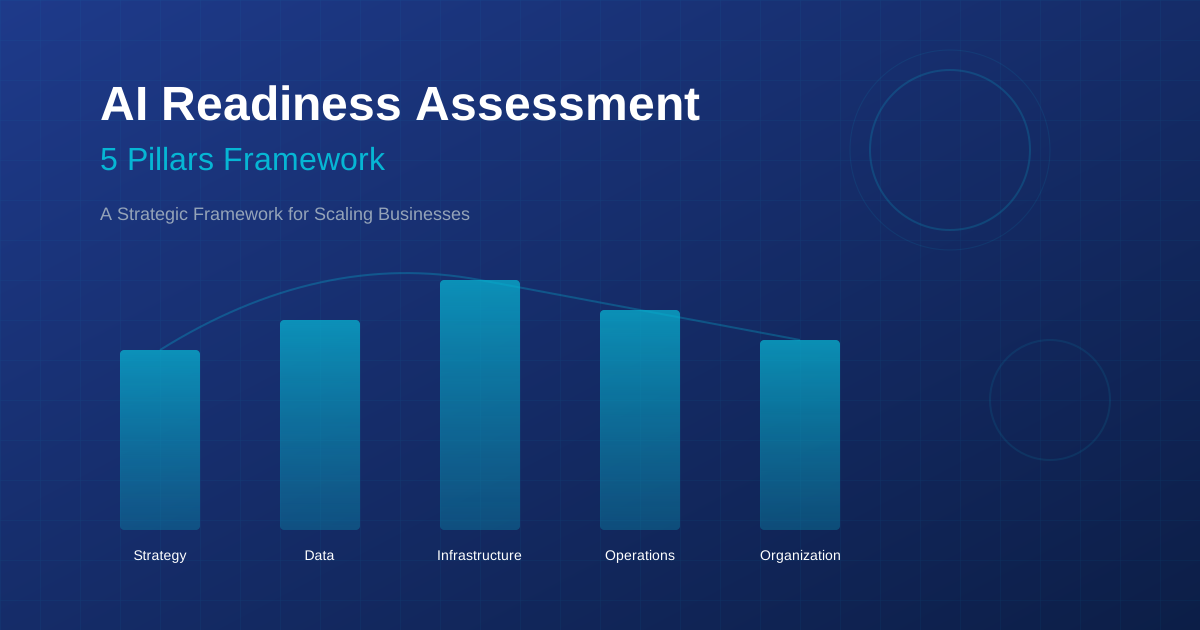
A scalable AI transformation depends on five foundational pillars.
1. Strategy Alignment
AI initiatives must align with core business goals.
Assess:
- Are AI use cases tied to revenue, cost savings, or customer experience?
- Is there executive sponsorship?
- Is AI part of long-term strategic planning?
Without strategy alignment, AI becomes experimentation rather than transformation.
2. Data Readiness for AI
AI performance depends on data quality and accessibility.
Evaluate:
- Is data centralized and structured?
- Are pipelines automated?
- Is governance defined?
- Are privacy and compliance standards enforced?
Data readiness is often the biggest bottleneck in enterprise AI adoption.
3. AI Infrastructure Readiness
Modern AI systems require scalable infrastructure.
Consider:
- Cloud-native architecture
- GPU and compute scalability
- CI/CD pipelines for models
- Monitoring and observability tools
- Secure model deployment practices
Infrastructure determines whether AI solutions remain prototypes or become production systems.
4. AI Operations & MLOps
AI must integrate into business workflows.
Review:
- Are models version-controlled?
- Is feedback collected for continuous improvement?
- Are automation triggers built into operational systems?
Operational readiness ensures AI outputs drive measurable impact.
5. Organization & Talent Readiness
Technology alone does not scale AI — people do.
Assess:
- AI literacy among leadership
- Availability of AI engineers or partners
- Change management processes
- Cross-functional collaboration
Cultural readiness determines adoption speed.
AI Readiness Maturity Levels: From Experimental to AI-Driven
Understanding maturity helps define next steps.
Level 1 – Experimental
- Isolated pilots
- No structured governance
- Minimal infrastructure
AI activity is exploratory.
Level 2 – Structured
- Defined use cases
- Early data pipelines
- Initial compliance policies
Organizations begin seeing targeted ROI.
Level 3 – Integrated
- AI embedded in workflows
- Cross-department adoption
- Scalable infrastructure
AI supports operational decision-making.
Level 4 – AI-Driven
- Predictive analytics guide strategy
- Continuous optimization loops
- Automated intelligence across systems
AI becomes a competitive advantage.
Common AI Readiness Gaps That Reduce ROI
Leaders frequently encounter:
- Overinvestment in tools without strategic clarity
- Weak data architecture
- Security and compliance blind spots
- No AI governance framework
- Lack of internal ownership
Addressing these gaps early reduces risk and increases long-term return.
AI Readiness Checklist: Self-Diagnostic for Business Leaders
Use this quick self-assessment. Score each from 1 (weak) to 5 (strong).
| Area | Score (1–5) |
|---|---|
| AI strategy aligned with KPIs | |
| Clean, centralized, AI-ready data | |
| Scalable cloud infrastructure | |
| Defined MLOps processes | |
| Executive-level AI ownership |
Scoring Guide:
- 5–10 → High Risk
- 11–18 → Developing
- 19–23 → Structured
- 24–25 → Advanced AI-ready organization
Why Founders Should Prioritize AI Readiness
AI adoption is not just a technology upgrade. It impacts:
- Revenue models
- Operational efficiency
- Customer experience
- Competitive positioning
Organizations that treat readiness as a strategic initiative reduce failure rates and accelerate scalable transformation.
Conclusion
Scaling AI successfully requires more than experimentation. A structured assessment across strategy, data, infrastructure, operations, and organizational readiness creates clarity and reduces risk. By understanding your maturity level and addressing foundational gaps, you build a roadmap toward becoming an AI-driven organization.
Frequently Asked Questions
🚀 Get Your AI Readiness Score
Complete a structured AI readiness assessment and receive:
- A maturity classification
- Gap analysis across 5 pillars
- Prioritized roadmap recommendations
Get your AI Readiness Score today and build a scalable AI foundation.