
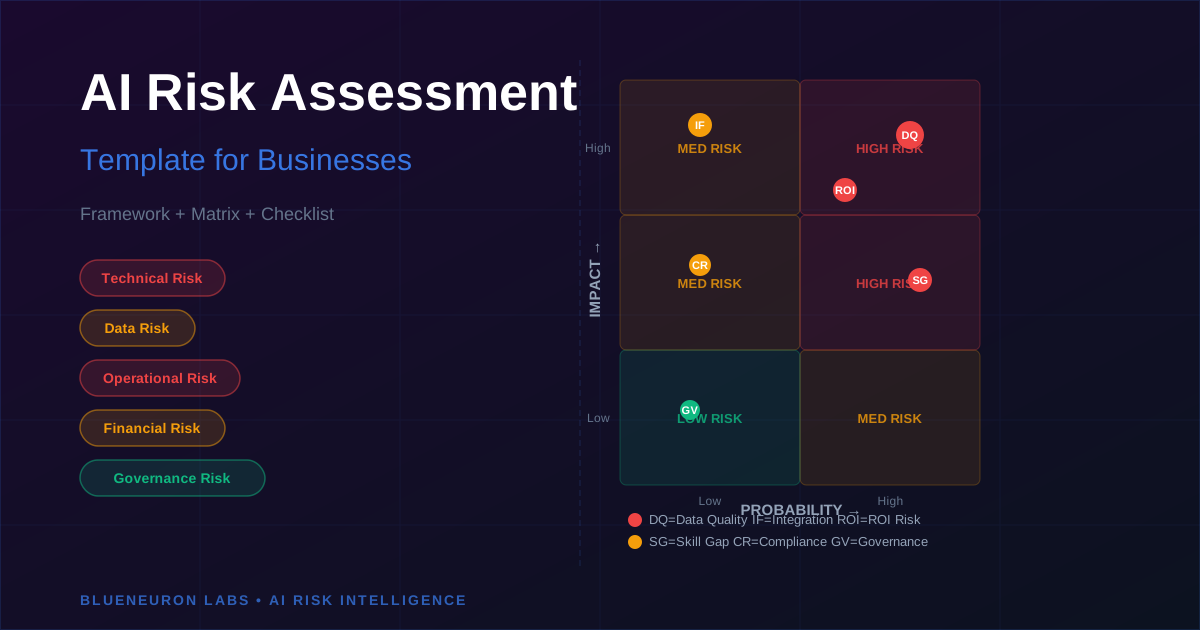
AI Risk Assessment Template for Businesses (Framework + Checklist)
Artificial intelligence investments are accelerating across industries. Yet despite the momentum, many AI initiatives fail to deliver measurable business value.
The issue is rarely the algorithm.
It is unmanaged risk.
Before allocating budget, hiring vendors, or committing to large-scale AI deployment, every organization should complete a structured AI Risk Assessment Template for Businesses.
This guide provides a practical, executive-level framework to help you:
- Identify AI implementation risks
- Evaluate AI project feasibility
- Use a structured AI risk assessment matrix
- Apply a clear AI risk assessment methodology
- Reduce financial and operational exposure
If you are planning to invest in AI, this framework will help you make informed decisions - not speculative ones.
Why AI Projects Fail Without Risk Assessment
AI projects do not fail because AI “doesn’t work.”
They fail because businesses underestimate complexity.
Common failure drivers include:
1. No Clear ROI Definition: AI initiatives are launched without measurable financial or operational targets.
2. Data Overestimation: Leaders assume existing data is usable - only to discover it requires months of cleaning and restructuring.
3. Infrastructure Gaps: Legacy systems cannot support AI deployment at scale.
4. Endless Pilot Cycles: Proof-of-concepts never transition into production.
5. Governance Blind Spots: Compliance, privacy, and accountability are addressed too late.
Without structured AI project risk evaluation, organizations expose themselves to unnecessary capital loss and reputational damage.
Before building your AI implementation roadmap, risk clarity must come first.
What Is an AI Risk Assessment?
An AI risk assessment is a structured process used to evaluate potential risks before implementing AI solutions.
It examines whether an AI initiative is:
- Technically feasible
- Financially viable
- Operationally sustainable
- Strategically aligned
- Governance-compliant
For business leaders, AI risks typically fall into five major categories.
1. Technical Risk
- Model accuracy uncertainty
- Integration challenges
- Infrastructure scalability limitations
- Vendor dependency
2. Data Risk
- Poor data quality
- Inconsistent historical records
- Bias within training data
- Data privacy vulnerabilities
This is where many AI initiatives silently collapse.
3. Operational Risk
- Lack of internal AI expertise
- Employee resistance
- Workflow disruption
- Undefined ownership
4. Financial Risk
AI investment risk analysis should include:
- Total cost of ownership
- Cloud infrastructure costs
- Ongoing model maintenance
- Vendor licensing
- Talent acquisition
Hidden costs often exceed initial projections.
5. Compliance & Governance Risk
AI governance risk includes:
- Regulatory exposure
- Lack of explainability
- Ethical concerns
- Accountability gaps
For enterprises and scaling companies, governance risk is strategic risk.
AI Risk Assessment Matrix (Example)
A structured AI risk assessment matrix transforms uncertainty into measurable evaluation.
Below is a simplified example:
| Risk Category | Probability | Impact | Mitigation Strategy |
|---|---|---|---|
| Poor Data Quality | High | High | Conduct full data audit before development |
| Integration Failure | Medium | High | Run limited pilot integration |
| ROI Uncertainty | Medium | High | Define measurable KPIs pre-launch |
| Skill Gap | High | Medium | Hire AI consultant or upskill team |
| Compliance Exposure | Low | High | Legal & governance review prior to deployment |
How to Use This Matrix
1. List all potential AI implementation risks
2. Assign probability (Low/Medium/High)
3. Assign business impact
4. Define mitigation strategy
5. Prioritize high-impact, high-probability risks
This process strengthens executive decision-making.
AI Risk Assessment Questionnaire (Business Checklist)
Use this AI risk assessment questionnaire before approving any AI investment.
Strategic Alignment
- Is this AI initiative tied to measurable business KPIs?
- Do we know what success looks like?
- Is executive sponsorship secured?
Data Readiness
- Do we have structured, reliable data?
- Is historical data sufficient for training?
- Are data governance controls in place?
Technical Feasibility
- Can existing systems integrate AI outputs?
- Is cloud infrastructure required?
- Do we have deployment capabilities?
Operational Preparedness
- Who owns AI performance?
- What happens if model outputs are incorrect?
- Is there a fallback or override mechanism?
Financial Evaluation
- Have we calculated full lifecycle costs?
- Is ROI measurable within 6–12 months?
- Is budget allocated for iteration?
If multiple answers remain unclear, your organization may require a structured AI feasibility assessment before proceeding.
AI Risk Assessment Methodology (Step-by-Step Framework)
A professional AI risk assessment methodology follows five structured steps.
Step 1: Define the AI Use Case
Avoid vague objectives like “improve operations.” Instead define: *“Reduce churn by 10% using predictive modeling within 9 months.”* Clarity reduces financial risk exposure.
Step 2: Identify Risk Dimensions
Evaluate across Technical, Data, Operational, Financial, and Governance. This ensures holistic risk coverage.
Step 3: Score Probability & Impact
Use a simple scoring framework: 1–5 scale or Low/Medium/High. Multiply probability × impact to prioritize. This converts assumptions into structured analysis.
Step 4: Validate Feasibility
Risk cannot be evaluated in isolation. It must connect with your broader AI readiness evaluation. If infrastructure maturity is low, implementation risk increases significantly.
Step 5: Build a Mitigation Roadmap
For each high-priority risk:
- Assign ownership
- Define timeline
- Establish monitoring controls
- Set measurable indicators
This directly supports your AI implementation roadmap and prevents stalled projects.
When a Template Is Not Enough
An internal template helps initiate structured discussions. But large-scale AI initiatives require deeper validation.
AI investments affect:
- Capital allocation
- Competitive positioning
- Operational stability
- Customer trust
- Regulatory exposure
A template identifies risk. A structured AI Risk & Feasibility Assessment evaluates whether the investment should proceed at all.
Before committing significant budget, combining risk analysis, feasibility validation, readiness evaluation, and strategic alignment reduces the probability of failed AI investments dramatically.
Frequently Asked Questions
Planning to Invest in AI?
AI investments can accelerate growth - or create costly setbacks.
We provide structured AI Risk & Feasibility Assessments designed to reduce failed AI initiatives and ensure strategic clarity before deployment.
If you’re considering AI adoption: