
The $3,000/Month Problem: Why AI for Marketing Agencies is the New Operational Standard
Revenue is growing. Clients are coming in. Your team is busy. But margins feel tighter every quarter.
If you run a 10-15 person digital marketing agency, you’ve likely felt this tension: Revenue is up… so why doesn’t profitability feel better?
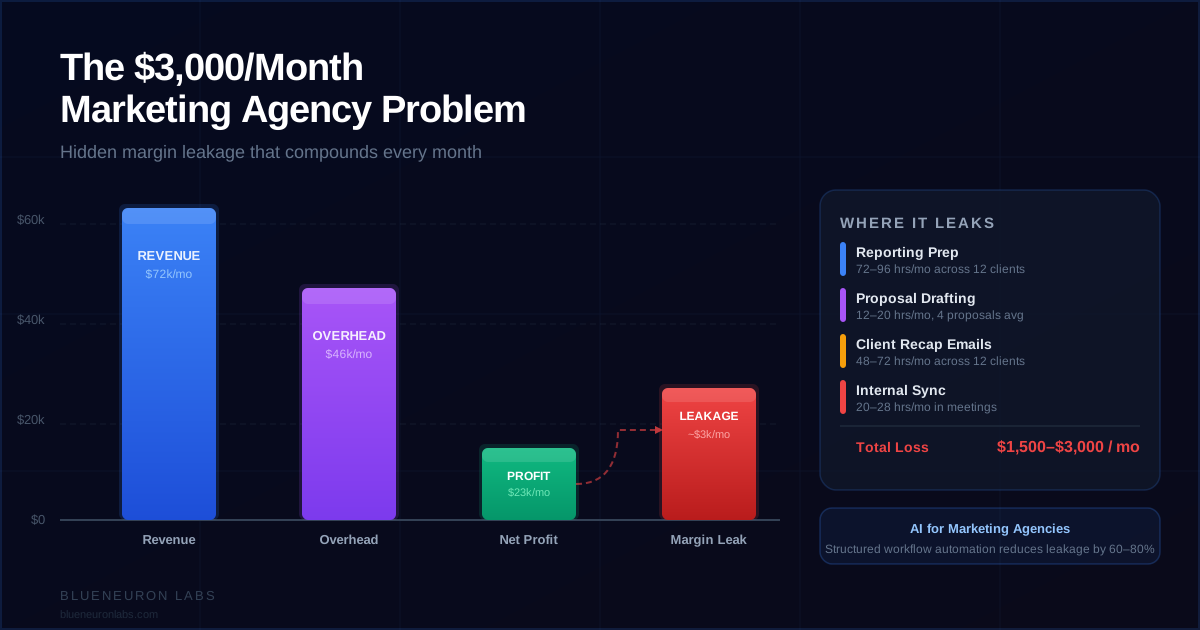
Here’s the uncomfortable reality. Most 5-25 person agencies are quietly leaking $1,500-$3,000 per month — not because they lack demand, talent, or clients. But because of operational repetition that compounds every single month.
And almost no one talks about it. However, the rise of AI for marketing agencies is quickly changing how founders address these hidden costs.
Revenue Growth ≠ Margin Growth
In theory, more clients should mean higher profit. In practice, revenue growth increases operational complexity. Every new client adds a layer of administrative friction that, if left unmanaged, erodes your bottom line.
Common digital marketing agency operations that scale linearly with client count:
- Reporting preparation and data visualization
- Strategy updates and client presentations
- Internal coordination and status meetings
- Proposal drafting for upsells and new business
- Performance recap emails and frequent commentary
- General administrative touchpoints
Unless systems are structured, operational overhead grows faster than founders expect. This is not about laziness or poor leadership; it is a structural issue that quietly erodes agency operational efficiency. Before building your AI implementation roadmap, risk clarity must come first.
A Time Audit of a 15-Person Agency
To understand where the money goes, we need to look at the recurring monthly work in a typical 15-person agency managing 12 active monthly retainer clients.
| Task Category | Estimated Time per Client | Total Monthly Hours (12 Clients) |
|---|---|---|
| Reporting Preparation | 6-8 hours | 72-96 hours |
| Proposal Drafting | 3-5 hours (per prop) | 12-20 hours (4 props) |
| Internal Campaign Sync | 5-7 hours (per week) | 20-28 hours |
| Client Recap Emails | 4-6 hours | 48-72 hours |
The Hidden Cost Calculation
If we take the lower end of these conservative estimates:
- Reporting: 72 hours
- Proposals: 12 hours
- Internal sync: 20 hours
- Recaps: 48 hours
- Total: 152 hours per month
Even if only 30-40% of that is repetitive operational work, that’s roughly 45-60 hours monthly. At a blended internal cost of $35-$50 per hour:
- 45 hours × $35 = $1,575
- 60 hours × $50 = $3,000
That is your $1,500-$3,000/month margin leak. It doesn't come from bad strategy; it comes from repeated operational patterns.
The Pattern-Based Work Insight
Most of this work follows a predictable structure. Performance summaries, proposal decks, and client update emails are often 70% similar across the board.
This is not creative work. It is structured repetition disguised as custom effort. When this repetition isn't systemized, it becomes hidden operational drag. This is where agency workflow automation becomes a structural necessity.
Why Hiring More People Makes It Worse
When workload increases, the default move is to hire. However, hiring solves capacity problems—not workflow inefficiencies. Without operational structure, adding more team members increases:
- Internal coordination complexity
- Documentation requirements
- Volume of internal communications (Slack/Email)
- Review and approval layers
Growth without structure compounds friction. This is why SMB operational efficiency is the primary strategic lever at the 5-25 person stage.
AI for Marketing Agencies: Workflow Infrastructure (Not Gimmicks)
Used correctly, AI for marketing agencies functions as workflow infrastructure. It is not about replacing strategists or automating creativity; it is about standardizing the recurring administrative layer.
- Standardizing recurring communication frameworks
- Assisting with structured reporting commentary
- Drafting from existing proposal frameworks
- Organizing internal documentation
- Summarizing repetitive updates
When AI is layered on top of structured systems, it increases agency operational efficiency. When layered on chaos, it simply amplifies chaos.
How to Audit Your Own Agency
Before implementing new technology, you must diagnose the leakage. Follow this five-step audit:
1. List All Recurring Monthly Tasks: Be exhaustive, from reporting to internal syncs.
2. Identify Pattern-Based Work: Ask if the task follows a structure or relies on templates.
3. Measure Time Per Client: Be honest; most founders underestimate this by 20-30%.
4. Calculate Internal Cost: Multiply time by blended hourly cost to see the real dollars.
5. Highlight Repeatable Tasks: If it repeats monthly with minor variation, it is automation-ready.
The Real Problem Isn’t Demand
5-25 person agencies don’t struggle because of a lack of clients. They struggle because operational drag compounds silently. Every additional client adds structured repetition, and without workflow design, margin compression is inevitable.
The agencies that win over the next three years won’t just grow revenue—they’ll grow structured leverage by implementing the right AI for marketing agencies.
Reflective Question
Where does your agency lose the most invisible time each month?
If you’re ready to fix your margin leakage:
Fixed Your Margin Leakage?
AI investments can accelerate growth - or create costly setbacks. We provide structured AI Risk & Feasibility Assessments designed to reduce failed AI initiatives and ensure strategic clarity before deployment.
If you’re considering AI adoption: