
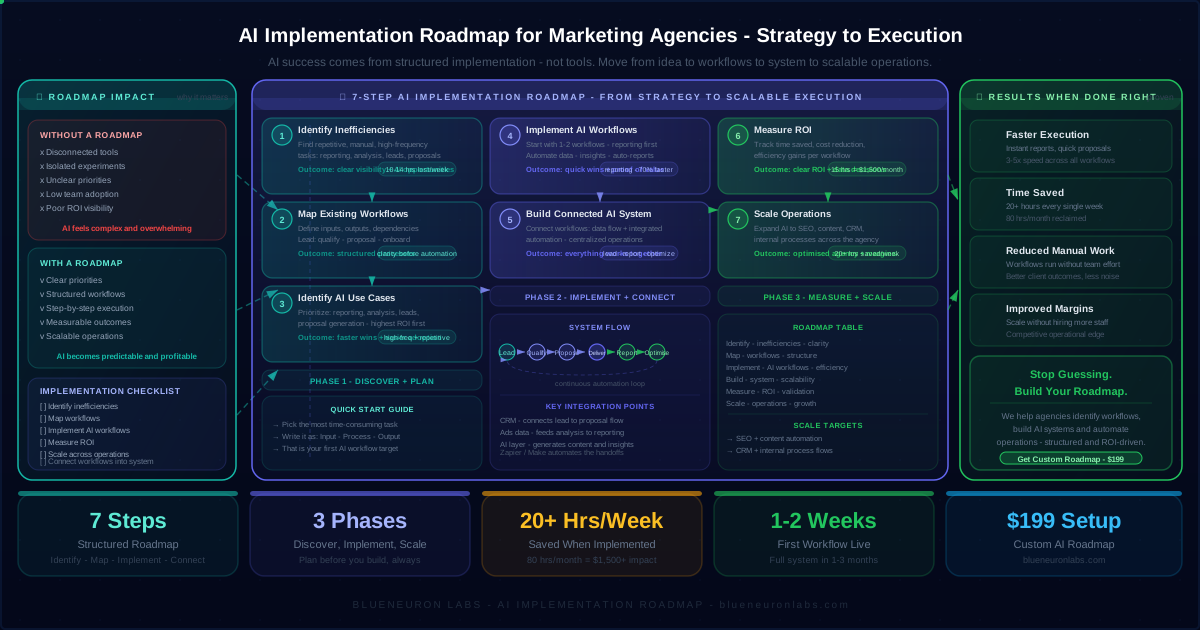
AI Implementation Roadmap for Marketing Agencies (Step-by-Step Strategic Framework)
Artificial intelligence is no longer an experimental advantage - it’s becoming a competitive necessity.
Yet most AI initiatives stall.
Not because the technology fails - but because the roadmap is unclear.
After conducting an AI Readiness Assessment, the next logical step is execution. This is where most organizations struggle. They know AI matters. They’ve identified opportunities. But they lack a structured path forward.
This guide provides a practical AI roadmap framework designed specifically for founders, CXOs, and scaling enterprises.
What Is an AI Roadmap?
An AI roadmap is a structured implementation plan that translates AI strategy into executable milestones, prioritized use cases, governance structures, and measurable ROI.
It answers:
- What should we build first?
- What data do we need?
- What infrastructure must be upgraded?
- Who owns AI internally?
- How do we scale beyond pilots?
Without a roadmap, AI becomes fragmented experimentation. With a roadmap, AI becomes transformation.
Why Most AI Roadmaps Fail
In our experience working with growing organizations, failures usually happen due to:
1. No Business Alignment: AI initiatives are started because they are “innovative,” not because they drive measurable impact.
2. Poor Data Foundations: Companies underestimate the effort required to clean, structure, and unify historical data before model deployment.
3. Endless Proof-of-Concept Cycles: AI pilots never transition into production.
4. Lack of Governance: Security, compliance, and ethical controls are considered too late.
An effective AI roadmap addresses these risks upfront.
Step 1: Conduct an AI Readiness Assessment
Before building an AI roadmap, assess your organizational readiness across:
- Strategy alignment
- Data maturity
- Infrastructure capability
- Operational processes
- Organizational skill readiness
A structured AI Readiness Assessment framework helps identify maturity gaps and prevents costly misalignment later.
Executive Considerations:
- Is AI tied to measurable business KPIs?
- Do we have executive sponsorship?
- Is there cross-functional buy-in?
Common Mistake: Jumping directly to vendor selection without assessing internal capability.
Step 2: Identify High-Impact AI Use Cases
Not all AI initiatives deliver equal value. Use a prioritization matrix: Impact vs Feasibility.
- High Impact + High Feasibility = Start Here
Evaluate:
- Revenue growth potential
- Cost reduction impact
- Operational efficiency gain
- Data availability
- Implementation complexity
Founder Insight: Start with use cases that deliver visible ROI within 3-6 months to build internal momentum. For inspiration on high-impact areas, explore AI for Digital Marketing Agencies: Practical Use Cases and AI Workflow Automation Examples.
Step 3: Build Your Data & Infrastructure Foundation
AI is only as strong as the data pipeline behind it. Your roadmap must address:
- Data integration strategy
- Data cleaning and labeling processes
- Cloud infrastructure readiness
- Model deployment architecture
- MLOps framework
Budget Considerations:
- Cloud compute costs
- Data engineering resources
- Model monitoring systems
- Security infrastructure
In scaling companies, underinvestment in infrastructure is where most AI roadmaps stall.
Step 4: Define Governance & Risk Controls
Enterprise AI without governance creates operational risk. Your roadmap must include:
- Model explainability standards
- Bias monitoring procedures
- Data privacy compliance
- Access control frameworks
- Audit mechanisms
For founders, this isn’t just technical - it’s brand protection. We recommend using a structured AI Risk Assessment Template to identify and mitigate these risks before they scale.
Step 5: Move from PoC to Scalable Deployment
The real transformation begins after the pilot phase.
Key considerations:
- Clear ownership (AI product owner)
- Defined production SLAs
- Continuous model retraining
- Performance tracking dashboards
- Integration into existing workflows
Scaling AI means embedding it into daily operations - not running it as a side experiment. To understand how to connect these pieces, see our guides on AI Workflow Automation for Marketing Agencies and How to Build an AI System.
AI Roadmap Timeline Example (12-Month View)
| Months | Key Activities |
|---|---|
| 0-3 | Readiness assessment, Use case prioritization, Infrastructure gap analysis |
| 3-6 | Data pipeline setup, First AI pilot launch, Governance framework design |
| 6-9 | Production deployment, KPI tracking, Iterative optimization |
| 9-12 | Expand to second use case, Organizational training, AI center of excellence formation |
This phased approach reduces risk while maintaining momentum.
Common AI Roadmap Mistakes to Avoid
- Treating AI as an IT project instead of a business initiative
- Overbuilding infrastructure before validating ROI
- Ignoring change management
- Failing to define measurable KPIs
- Scaling without governance
- Failing to address common AI implementation mistakes early in the process
Frequently Asked Questions
👉 Related: Reduce Reporting Time by 70% Using AI · AI Workflow Automation for Marketing Agencies · Best AI Tools for Marketing Agencies in 2026
Final Thoughts: From Strategy to Scalable Execution
An AI roadmap is not a technical document. It is a transformation blueprint. For founders and enterprise leaders, the goal is not to “experiment with AI.” The goal is to systematically embed intelligence into operations, decision-making, and customer experience.
If you haven’t completed your AI Readiness Assessment yet, start there.
*Execution without readiness leads to friction. Execution with clarity leads to scale.*
Related Resources:
- The $3,000/Month Problem Inside 5–25 Person Agencies
- How Marketing Agencies Can Save 20+ Hours Per Week Using AI Workflows (ROI Guide)
- How to Build an AI System for Your Marketing Agency
- Common AI Implementation Mistakes (And How to Avoid Them)
- How Marketing Agencies Can Reduce Reporting Time by 70% Using AI
- How Marketing Agencies Can Automate Campaign Analysis Using AI
- AI Lead Qualification for Marketing Agencies: Automate Your Sales Pipeline
- How Marketing Agencies Can Use AI to Generate Client Proposals Faster
- AI Workflow Automation Examples for Marketing Agencies (Real Use Cases)
- AI for Digital Marketing Agencies: Practical Use Cases
- AI Workflow Automation for Marketing Agencies: How Agencies Can Automate Operations with AI