
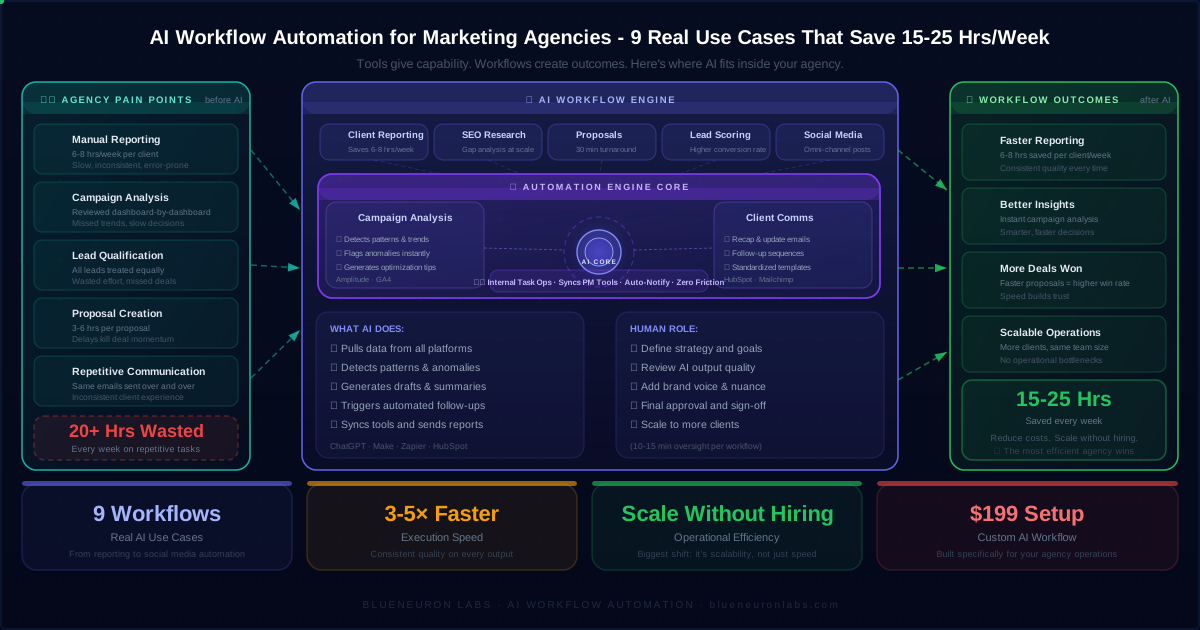
AI Workflow Automation Examples for Marketing Agencies (Real Use Cases)
Introduction
Most marketing agencies today have started exploring AI. But there’s still a major gap. Teams know about tools. They’ve tried a few experiments. But they don’t know where AI actually fits into their day-to-day operations.
This creates confusion. 👉 Should AI be used for content? Reporting? Campaign optimization?
The problem isn’t lack of tools. It’s lack of clarity. Most agencies don’t think in workflows; they think in isolated tasks. And that’s why adoption feels scattered.
This article solves that. Instead of theory or tool lists, we’ll break down real AI workflow automation examples used inside marketing agencies - and how they directly impact time, efficiency, and revenue.
By the end, you’ll see exactly where AI fits inside your agency.
What AI Workflow Automation Means
Before diving into examples, it’s important to clarify one thing: 👉 AI tools are not workflows.
A tool gives capability. A workflow creates outcomes.
- Tool: What you use (e.g., ChatGPT).
- Workflow: How work gets done (e.g., Automated Client Reporting).
For example, using an AI tool to write a report is not automation. But building a system where data is collected automatically, insights are generated, and reports are created and sent - that is an AI workflow.
This distinction is critical because agencies that focus on workflows scale.
Why Agencies Are Adopting AI Workflows
Marketing agencies are under increasing pressure. More clients. More campaigns. More data. But the team size often stays the same.
This leads to:
- Repetitive manual work
- Slower execution
- Operational bottlenecks
AI workflows solve this by:
- Reducing repetitive tasks
- Standardizing processes
- Improving speed and consistency
👉 The result? Better efficiency without increasing headcount.
AI Workflow Automation Examples
Below are real, practical workflow examples you can apply immediately.
1. Client Reporting Automation
Problem: Manual reporting takes hours every week. Teams collect data, analyze performance, and write insights manually for each client.
AI Workflow Solution: AI automates the entire reporting pipeline by pulling data from multiple platforms, analyzing campaign performance, generating structured summaries, and formatting reports automatically.
*Related:* Automate Client Reporting Workflows
👉 Outcome: Saves 6–8 hours per week and improves consistency in reporting.
2. Campaign Analysis Automation
Problem: Campaign performance analysis is done manually by reviewing dashboards and identifying trends. This is time-consuming and inconsistent.
AI Workflow Solution: AI workflows detect performance patterns, identify anomalies, and generate optimization insights instantly.
*Related:* AI Workflow Automation for Campaign Analysis
👉 Outcome: Faster decision-making and more consistent insights.
3. Lead Qualification Automation
Problem: Agencies spend time filtering leads manually, often treating all leads equally. This leads to wasted effort and missed opportunities.
AI Workflow Solution: AI automates lead qualification by scoring leads based on criteria, filtering high-quality prospects, and triggering automated responses.
*Related:* AI Use Cases for Agencies
👉 Outcome: Higher conversion rates and faster response times.
4. Proposal Generation Automation
Problem: Creating proposals takes hours and delays responses to potential clients, killing deal momentum.
AI Workflow Solution: AI workflows generate proposal drafts, customize based on client inputs, and automate follow-ups.
*Related:* Reduce Manual Work in Agencies
👉 Outcome: Faster turnaround time and increased win rates.
5. SEO Keyword Research Automation
Problem: Keyword research is time-consuming and requires analyzing large datasets across multiple tools.
AI Workflow Solution: AI helps by clustering keywords, identifying search intent, and suggesting content opportunities based on gap analysis.
👉 Outcome: Faster content planning and improved SEO strategy.
6. Content Generation Workflow
Problem: Creating blogs, ad copy, and marketing content takes significant time to research and draft.
AI Workflow Solution: AI workflows generate content drafts, suggest structural improvements, and assist with creative ideation at scale.
👉 Outcome: Faster content production and improved team productivity.
7. Client Communication Automation
Problem: Teams repeatedly send similar emails such as recovery updates, summaries, and follow-ups.
AI Workflow Solution: AI generates campaign summaries, recap emails, and response templates based on live performance data.
👉 Outcome: Saves time on communication and improves response consistency.
8. Internal Task Automation
Problem: Internal coordination takes time-task updates, tool syncing, and tracking progress across different systems.
AI Workflow Solution: AI workflows automate task updates, sync project management tools, and streamline notifications from one dashboard.
*Related:* AI Workflow Automation for Agencies
👉 Outcome: Improved team efficiency and reduced operational friction.
9. Social Media Automation
Problem: Posting content manually across platforms takes time and constant monitoring for engagement.
AI Workflow Solution: AI generates social content variations, schedules posts, and optimizes posting times based on audience behavior.
👉 Outcome: Consistent posting schedules and significant time savings.
Summary Table: AI Workflow Impact
| Workflow | Key Outcome |
|---|---|
| Reporting | Time saved monthly |
| Analysis | Faster campaign insights |
| Leads | Higher conversion rate |
| Proposals | Faster deal closing |
| SEO | Faster topical research |
| Content | Increased draft output |
| Communication | standardized follow-ups |
| Internal Ops | Scalable efficiency |
| Social Media | Omni-channel consistency |
Business Impact of AI Workflows
When these workflows are combined, the impact is significant. Agencies can save 15–25 hours per week, reduce operational costs, and scale without hiring.
*See also:* Save Time Using AI Workflows
👉 The biggest shift is not just efficiency-it’s scalability.
Common Mistakes Agencies Make
1. Focusing Only on Tools: Tools without workflows don’t create results in isolation.
2. Lack of Workflow Clarity: Without defined processes, automation fails to scale.
3. Overcomplicating Implementation: Starting too big leads to internal confusion.
4. Ignoring Outcomes: Without tracking results, the ROI of AI remains unclear.
How to Start with AI Workflows
1. Step 1: Identify Repetitive Tasks - Focus on work that repeats frequently and manual entry.
2. Step 2: Map Workflows - Understand inputs, outputs, and software dependencies.
3. Step 3: Apply AI - Introduce AI where patterns and data exist.
4. Step 4: Test - Start with one workflow (like reporting or analysis).
5. Step 5: Scale - Expand gradually across your entire operations.
Frequently Asked Questions
Conclusion
AI is no longer just a trend in marketing; it’s becoming part of how agencies operate. But the real value doesn’t come from tools-it comes from workflows.
Agencies that adopt AI workflows reduce manual effort, improve efficiency, and scale operations faster. The agencies that win won’t be the ones using the most tools; they’ll be the ones with the most efficient systems.
🚀 See How AI Can Transform Your Agency Workflows
AI workflows are not about replacing your team. They are about removing the repetitive work that slows you down. We help marketing agencies build custom AI workflows tailored to their operations.
👉 Get your AI workflow for $199