
AI Marketing Operations Automation: Best Tools, Platforms & Agencies Compared (2026)
Introduction
If your marketing agency is still running campaign reporting, client updates, and performance analysis manually - you are losing 15–20 hours per week to work that AI can handle automatically.
For agencies with 5–25 employees, this is not a minor inefficiency. It is a growth ceiling. Every hour spent pulling data, formatting reports, and drafting proposals is an hour not spent on strategy, client relationships, or new business.
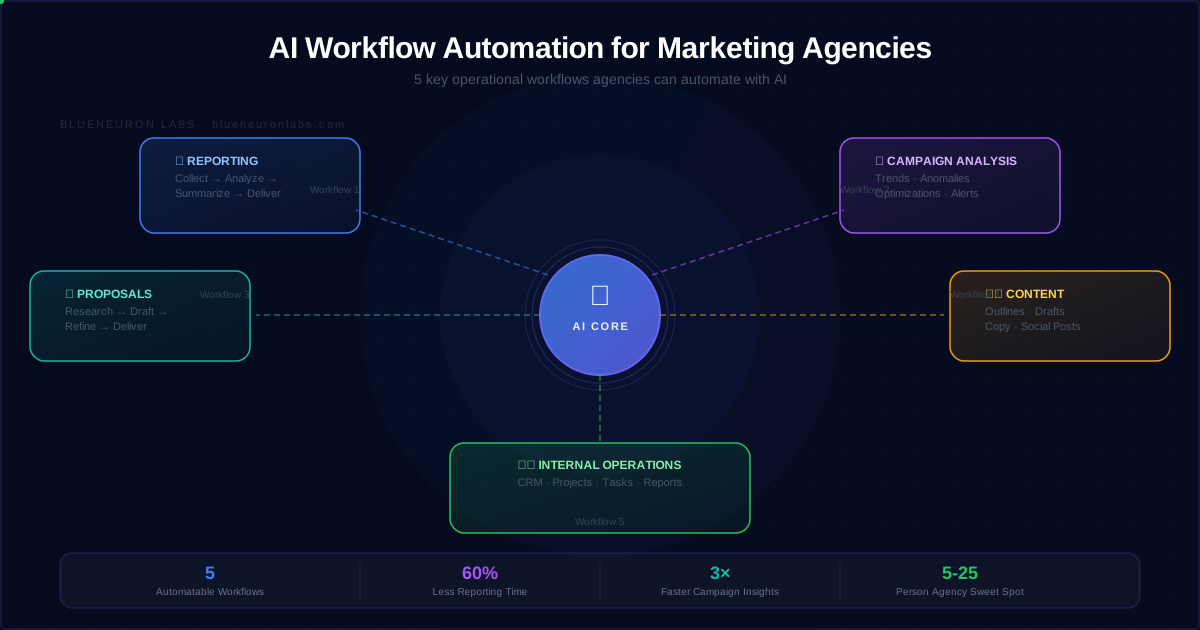
AI workflow automation for marketing agencies has moved well beyond content generation and ad optimization. In 2026, agencies are automating entire operational workflows - reporting pipelines, campaign analysis, proposal generation, lead qualification, and internal coordination - using tools that cost less than a single employee hour per day.
This guide covers exactly which AI tools and platforms deliver the highest ROI for marketing operations, how agencies are structuring these workflows, and a practical implementation roadmap you can start this week.
Why Marketing Agencies Are Adopting AI Operations Automation
The numbers behind AI adoption in marketing are no longer speculative.
According to McKinsey & Company research on generative AI, organizations integrating AI into operational workflows report productivity improvements of 20–40% on repeatable task categories. For marketing agencies, the highest-impact categories are reporting, data analysis, and client communication.
Gartner's 2025 survey on GenAI in marketing found that marketing teams are increasingly applying AI to data-heavy operational tasks - particularly campaign analysis and performance reporting - where manual effort is highest and automation ROI is clearest.
For a 10-person marketing agency billing $15,000–$50,000 per month per client, reducing 20 hours of manual operations work per week translates directly into capacity for one additional client without a new hire.
That is the core business case for AI marketing operations automation in 2026.
What Is AI Workflow Automation for Marketing Agencies?
AI workflow automation refers to using artificial intelligence systems to handle repetitive operational tasks that normally require manual effort from your team.
In a marketing agency context, this means:
- Campaign performance data is collected, analyzed, and summarized automatically
- Client reports are generated and formatted without manual input
- Proposals are drafted using AI based on client briefs and past work
- Lead qualification and CRM updates happen without manual data entry
- Internal task coordination is triggered automatically based on campaign events
These are not hypothetical capabilities. They are live workflows running inside agencies today using tools like Zapier, Make, Supermetrics, and ChatGPT - most of which cost under $100 per month.
The important distinction: AI workflow automation does not replace your marketing team. It removes the repetitive operational layer so your team focuses on strategy, creative thinking, and client relationships - the work that actually requires human judgment.
Which AI Solutions Have the Highest Measurable Impact on Marketing Workflows?
Based on implementation data across marketing agencies, the workflows with the highest measurable ROI from AI automation are:
1. Client Reporting Automation
Time saved: 8–15 hours per month per client
Manual reporting is the single largest time drain in most marketing agencies. Teams spend hours collecting data from Google Ads, Meta, LinkedIn, and analytics platforms - then formatting it into client-ready documents.
AI automation eliminates most of this. Tools like Supermetrics automatically pull campaign data from all connected platforms into a single dashboard or Google Sheet. ChatGPT or Claude then generates written performance summaries, trend analysis, and recommendations in minutes.
Agencies running 10+ clients report saving 80–120 hours per month on reporting alone after implementing this workflow.
2. Campaign Performance Analysis
Time saved: 5–10 hours per week
Monitoring campaign performance across multiple clients and platforms requires constant attention. Without automation, marketers manually check dashboards, identify anomalies, and compile findings.
AI-powered analysis tools can monitor campaign metrics continuously, flag underperforming ad sets automatically, and surface optimization opportunities before they become problems. What previously took a team member 2 hours of daily monitoring can be compressed into a 15-minute review of AI-generated alerts.
3. Proposal and Strategy Generation
Time saved: 3–5 hours per proposal
Agencies preparing proposals for new clients repeat the same research and writing tasks for every pitch. AI automation tools can generate proposal drafts, competitive analysis summaries, and strategy outlines based on a client brief in under 30 minutes.
Agencies using AI-assisted proposal workflows report reducing proposal preparation time from an average of 4–6 hours to 45–90 minutes per proposal.
4. Lead Qualification and CRM Automation
Time saved: 4–8 hours per week
Manually qualifying inbound leads, updating CRM records, and triggering follow-up sequences is time-consuming and error-prone. AI automation can score leads based on defined criteria, update CRM fields automatically, and trigger personalized follow-up sequences without manual input.
5. Internal Operations and Project Coordination
Time saved: 3–6 hours per week
Internal task management - updating project status, notifying team members, coordinating campaign deliverables - can be automated using workflow tools connected to your project management platform. When a campaign milestone is completed, the next task is automatically assigned. When a client approves a proposal, onboarding tasks are triggered automatically.
Best AI Tools for Marketing Operations Automation in 2026
Choosing the right tool stack is the most common point of confusion for agencies starting with AI automation. Below is a comparison of the most widely used platforms, their primary use case, and current pricing.
Tool Comparison Table
| Tool | Best For | Key Capability | Starting Price |
|---|---|---|---|
| Zapier | Workflow automation & app connections | 6,000+ app integrations, trigger-based automation | Free / $19.99/mo |
| Make (formerly Integromat) | Complex multi-step workflows | Visual workflow builder, advanced logic | Free / $9/mo |
| Supermetrics | Reporting data aggregation | Auto-pulls data from 100+ ad & analytics platforms | $99/mo |
| ChatGPT (GPT-4o) | Report writing, proposals, analysis summaries | Natural language generation, data interpretation | $20/mo |
| Claude (Anthropic) | Long-form analysis, structured content generation | Handles large data inputs, nuanced writing | $20/mo |
| HubSpot AI | CRM automation + campaign management | End-to-end marketing ops with AI features | $45/mo |
| Notion AI | Internal SOPs, project coordination | AI writing + knowledge base + task management | $10/mo |
| Google Looker Studio | Automated reporting dashboards | Free, connects to Google ecosystem | Free |
| Bardeen | Browser-based workflow automation | Scraping, CRM updates, no-code automation | Free / $10/mo |
How to Choose the Right Stack for Your Agency Size
Solo or 1–3 person agency (budget: under $50/month)
Start with: Zapier (free tier) + ChatGPT ($20/mo) + Google Looker Studio (free)
Focus on: Automating client reporting first - highest immediate ROI
Small agency 4–10 people (budget: $100–$300/month)
Stack: Make ($9/mo) + Supermetrics ($99/mo) + ChatGPT ($20/mo) + Notion AI ($10/mo)
Focus on: Reporting automation + proposal generation + internal coordination
Growing agency 10–25 people (budget: $300–$600/month)
Stack: Make Pro + Supermetrics + HubSpot AI + ChatGPT + Notion AI
Focus on: Full operations automation - reporting, CRM, lead qualification, project management
What AI Marketing Operations Tools Can Help Me Streamline Workflows?
The most practical way to think about AI marketing operations tools is by workflow category. Here is how specific tools map to the workflows agencies automate most frequently:
| Workflow | Tool(s) to Use | What Gets Automated |
|---|---|---|
| Client reporting | Supermetrics + ChatGPT + Looker Studio | Data collection, analysis, report writing |
| Campaign monitoring | Zapier + Make + platform alerts | Anomaly detection, performance alerts |
| Proposal generation | ChatGPT + Notion AI | First draft, competitive summary, pricing sections |
| Lead qualification | HubSpot AI + Zapier | Lead scoring, CRM update, follow-up trigger |
| Internal task management | Notion AI + Make + Slack | Task assignment, status updates, team notifications |
| Campaign analysis summaries | ChatGPT + Supermetrics | Performance narrative, trend identification |
Can AI-Assisted Marketing Operations Workflows Improve Business Outcomes?
Yes - with one important condition: the automation must be implemented against specific, well-defined workflows. Generic AI adoption without workflow mapping produces inconsistent results.
When agencies implement AI automation against specific operational problems, the business outcomes are measurable and consistent:
Capacity increase without hiring
Agencies that automate reporting and analysis typically free up 15–20 hours per week across a 5–10 person team. That capacity translates directly into the ability to take on 1–2 additional clients without increasing headcount.
Faster client response times
Automated campaign monitoring means performance issues are flagged and communicated to clients within hours instead of days. Agencies report measurable improvements in client satisfaction scores after implementing real-time alert workflows.
Improved proposal win rates
Agencies using AI-assisted proposal generation report 15–25% improvement in proposal output volume - more proposals submitted means more opportunities to win. Quality consistency also improves because AI-generated drafts follow a structured format every time.
Reduced operational errors
Manual data entry and report formatting introduce errors that damage client trust. Automated data pipelines eliminate the copy-paste step where most reporting errors occur.
The condition for all of these outcomes: the automation must be built around your agency's actual workflows, not generic templates. This is why agencies that partner with specialists like Blue Neuron Labs - who design custom AI automation systems - see faster and more consistent results than agencies experimenting with tools independently.
What Are the Most Affordable Options for Automating Repetitive Tasks in a Marketing Operations Team?
For agencies with limited budgets, the highest-ROI starting point is always reporting automation - it saves the most time at the lowest cost.
Under $30/month:
- Zapier (free tier, up to 100 tasks/month) + ChatGPT ($20/mo)
- Use case: Automate report summaries for 2–3 clients using ChatGPT connected to Google Sheets via Zapier
- Time saved: 4–6 hours/month
Under $100/month:
- Make ($9/mo) + ChatGPT ($20/mo) + Google Looker Studio (free)
- Use case: Multi-step reporting workflow pulling from Google Ads + Meta Ads, generating AI summaries, delivering to client via email automatically
- Time saved: 10–15 hours/month
Under $200/month:
- Make ($9/mo) + Supermetrics ($99/mo) + ChatGPT ($20/mo)
- Use case: Full reporting automation across all major ad platforms, AI-generated insights, auto-formatted client reports
- Time saved: 20–30 hours/month
Under $400/month:
- Make Pro ($16/mo) + Supermetrics ($99/mo) + HubSpot Starter ($45/mo) + ChatGPT ($20/mo) + Notion AI ($10/mo)
- Use case: End-to-end operations automation - reporting, CRM, lead qualification, internal coordination
- Time saved: 30–50 hours/month
The important framing: at an agency billing rate of $75–$150/hour, saving 20 hours per month at $200/month in tools delivers $1,500–$3,000 in recovered capacity for a $200 investment.
How Do Agencies Productize AI Marketing Automation Packages?
A growing number of marketing agencies are not just using AI automation internally - they are packaging it as a service offering for clients.
The most common productized AI automation service structures are:
Starter Automation Package - $500–$1,500/month
- Automated monthly reporting (1–2 platforms)
- AI-generated performance summary
- Campaign alert setup
- Best for: Small business clients, e-commerce brands
Growth Automation Package - $1,500–$3,500/month
- Full reporting automation (all platforms)
- Weekly AI campaign analysis
- Proposal template automation
- CRM lead qualification setup
- Best for: Mid-size businesses, multi-channel campaigns
Operations Automation Package - $3,500–$7,500/month
- Custom AI workflow design across all agency operations
- Real-time campaign monitoring and alerting
- Internal operations automation (project management, client communication)
- Monthly optimization and system maintenance
- Best for: Established businesses, agencies, multi-location brands
Agencies productizing AI automation typically price based on the number of automated workflows, platforms connected, and time saved per month - not just tool costs.
How to Start AI Workflow Automation in Your Agency - Step by Step
Step 1 - Audit your most repetitive tasks (1 hour)
List every task your team repeats weekly. Look for tasks that follow the same pattern each time - collecting data, formatting documents, sending updates, updating records.
Step 2 - Rank by time cost (30 minutes)
Estimate how many hours per week each task consumes. Multiply by your team's effective hourly cost. Tasks costing $500+ per month in team time are immediate automation candidates.
Step 3 - Map the workflow inputs and outputs (1 hour)
For your top 2–3 candidates, write down: what triggers the task, what data or inputs it requires, what the output looks like, and where that output goes. This workflow map is what an automation tool like Make or Zapier needs to replicate the process.
Step 4 - Build a pilot automation (1–2 days)
Start with your highest-cost workflow. Build a minimal version using free or low-cost tools. Do not try to automate everything at once - a working pilot on one workflow teaches you more than a failed attempt at five.
Step 5 - Measure and expand (ongoing)
Track time saved per week after implementation. Once a workflow is stable, move to the next highest-cost task. Most agencies find that the first successful automation builds internal confidence for broader adoption.
For agencies that want to skip the trial-and-error phase, Blue Neuron Labs designs and builds custom AI automation systems mapped to your specific workflows - typically deployed in 2–4 weeks.
AI Workflow Automation for Marketing Agencies - Quick Reference Checklist
Use this checklist when evaluating AI automation for your agency:
- [ ] Audit all recurring operational tasks across reporting, analysis, proposals, and internal coordination
- [ ] Identify the 3 workflows consuming the most team hours per week
- [ ] Map inputs, outputs, and triggers for each candidate workflow
- [ ] Select tools based on agency size and budget (see tool comparison table above)
- [ ] Build and test a pilot automation on your highest-cost workflow
- [ ] Measure hours saved per week after 30 days
- [ ] Expand to next workflow based on results
- [ ] Evaluate AI readiness using a structured [AI Readiness Assessment
- [ ] Assess implementation risks using an [AI Risk Assessment Template
Manual vs Automated Marketing Operations - Comparison
| Task | Manual Process | AI Automated Process | Time Saved |
|---|---|---|---|
| Client reporting | Pull data from each platform, format manually, write summary | Supermetrics pulls data automatically, ChatGPT writes summary | 8–15 hrs/month/client |
| Campaign analysis | Check dashboards daily, manually identify trends | AI monitors continuously, flags anomalies automatically | 5–10 hrs/week |
| Proposal preparation | Research, draft, format from scratch each time | AI generates structured draft from client brief | 3–5 hrs/proposal |
| Lead qualification | Manually review and score each lead, update CRM | AI scores leads automatically, updates CRM, triggers follow-up | 4–8 hrs/week |
| Internal coordination | Manual task assignment, status updates via email | Automated triggers assign tasks and notify team | 3–6 hrs/week |
Frequently Asked Questions
Conclusion
AI workflow automation for marketing agencies in 2026 is not a future capability - it is a current operational advantage that agencies are using to scale without increasing headcount, deliver faster client insights, and build more profitable service models.
The agencies seeing the highest ROI are not necessarily those with the largest tool budgets. They are the agencies that identified their highest-cost workflows, built focused automations against specific operational problems, and measured results before expanding.
The starting point is always the same: audit your weekly tasks, find where the hours are going, and build one automation that recovers them.
If you want to skip the trial-and-error phase and implement AI automation systems that are custom-built for your agency's workflows, Blue Neuron Labs designs and deploys these systems for marketing agencies - typically within 2–4 weeks.
👉 Related: How Marketing Agencies Reduce Reporting Time by 70% Using AI · AI Workflow Automation Examples for Marketing Agencies · AI Workflow Automation Cost for Marketing Agencies · Best AI Tools for Marketing Agencies in 2026
🚀 Ready to Automate Your Agency's Operations?
Blue Neuron Labs builds custom AI workflow automation systems for marketing agencies - from reporting pipelines to full operations automation. We design, build, and deploy the systems so your team can focus on client work.