
How AI Can Automate Client Reporting in Marketing Agencies
The Hidden Reporting Burden in Marketing Agencies
Client reporting is one of the most time-consuming operational tasks inside marketing agencies.
Every month, teams must:
- collect campaign data
- analyze performance metrics
- write performance commentary
- format structured reports
- deliver insights to clients
For agencies with multiple clients, this process quickly becomes operationally heavy.
Many founders underestimate how much time reporting consumes across their team.
What begins as a simple monthly update can evolve into dozens of hours of manual work.
This problem is closely connected to broader operational inefficiencies inside marketing agencies discussed in the article about the $3,000/Month operational problem affecting growing agencies.
In many cases, reporting workflows silently consume time that could otherwise be spent on strategy, campaign optimization, or client acquisition.
This is why AI client reporting automation for marketing agencies is gaining attention among agency operators.
Instead of replacing marketing expertise, AI helps automate repetitive reporting processes while allowing teams to focus on strategic decision-making.
Why Reporting Becomes a Bottleneck in Growing Agencies
Reporting complexity increases as agencies grow.
The issue is not simply the volume of data.
The challenge lies in converting marketing data into meaningful client communication.
Several operational tasks contribute to this bottleneck.
Data Collection Across Multiple Platforms
Marketing agencies typically manage campaigns across several platforms.
Common sources include:
- Google Ads
- Meta advertising platforms
- SEO tools
- Analytics dashboards
- CRM systems
Each platform contains important campaign performance data.
However, collecting that data manually every month requires significant time.
Even with dashboards, teams often export spreadsheets to verify metrics and organize data before building reports.
Interpreting Marketing Performance
Raw metrics rarely provide meaningful insight on their own.
Clients expect explanations such as:
- why campaign performance changed
- which channels produced conversions
- which campaigns require adjustments
This interpretation process takes time and analytical effort.
Writing Performance Commentary
Another major time investment is insight writing.
Many agencies create written explanations including:
- campaign highlights
- performance trends
- optimization recommendations
Although valuable, this process often repeats each month with similar structure.
Report Formatting and Presentation
Finally, reports must be formatted into a client-friendly format.
This often includes:
- charts
- visual dashboards
- summary sections
- performance comparisons
When multiplied across several clients, report formatting alone can consume many hours.
For agencies with 5–25 employees, reporting can easily require 20–50 hours per month.
This is where marketing agency reporting automation begins to deliver operational value.
What Parts of Client Reporting AI Can Automate
Artificial intelligence can significantly improve reporting workflows.
However, automation should be applied to the right tasks.
AI works best when handling structured, repetitive processes.
Below are the key areas where AI can assist agencies.
Automated Data Aggregation
AI-powered systems can automatically collect campaign data from marketing platforms.
Instead of manually exporting reports, automated pipelines can retrieve performance metrics continuously.
This reduces the need for repetitive data gathering.
Campaign Performance Analysis
AI tools can analyze campaign data to identify:
- performance trends
- anomalies in metrics
- cost-efficiency changes
- conversion fluctuations
These insights allow agencies to detect important campaign patterns quickly.
Natural Language Insight Generation
Modern AI systems can generate written summaries describing campaign performance.
Examples include:
- explaining metric changes
- summarizing key campaign results
- identifying optimization opportunities
These summaries can act as a draft that agency teams refine before sending reports to clients.
Trend Detection
AI models can identify long-term patterns across multiple reporting periods.
This allows agencies to detect:
- seasonal performance changes
- audience behavior shifts
- campaign growth trends
Trend detection helps agencies provide deeper insights to clients.
Report Formatting and Visualization
AI reporting tools can automatically generate structured reports including:
- visual charts
- performance dashboards
- formatted summaries
These reports follow predefined templates, reducing manual formatting work.
Human Oversight Still Matters
Despite automation, certain responsibilities must remain with agency teams.
These include:
- strategic marketing decisions
- interpreting complex campaign context
- validating AI insights
- communicating recommendations to clients
AI supports operational efficiency but does not replace marketing expertise.
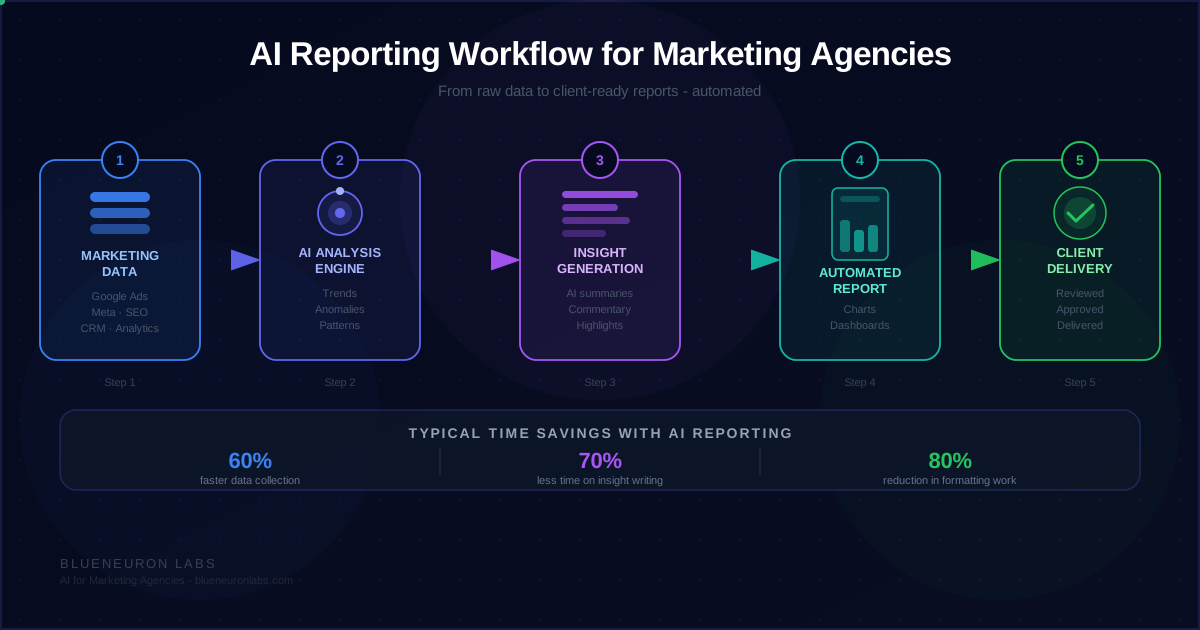
Example AI Reporting Workflow for Agencies
To understand how AI reporting tools for agencies operate in practice, consider a simple workflow.
Step 1 - Marketing Data Collection
Campaign data is automatically collected from marketing platforms such as advertising systems, analytics dashboards, and SEO monitoring tools. No manual exports are required.
Step 2 - AI Performance Analysis
AI analyzes performance metrics to detect campaign trends, performance changes, and unusual patterns. This analysis happens continuously as data updates.
Step 3 - Insight Generation
AI generates structured commentary summarizing campaign performance including campaign highlights, performance declines, and growth opportunities. These insights act as a draft for agency review.
Step 4 - Automated Report Creation
The reporting system generates a structured report including charts, campaign summaries, and performance commentary following predefined agency templates.
Step 5 - Team Review and Client Delivery
Agency teams review the report, validate insights, and add strategic recommendations. Once approved, the report is delivered to clients.
This process significantly reduces manual reporting work while maintaining reporting quality.
When Agencies Should Start Implementing AI
Not every agency needs reporting automation immediately.
However, certain indicators suggest it may be time to adopt AI.
Agency Size Indicators
Agencies with 5–25 employees often experience operational strain as client numbers increase.
At this stage, reporting tasks may consume large portions of team capacity.
Workload Indicators
Consider automation when:
- reporting requires more than 20 hours monthly
- multiple team members handle reporting
- reporting cycles delay other strategic work
Reporting Complexity
Automation becomes especially useful when agencies manage campaigns across multiple platforms.
Before implementing AI systems, agencies should evaluate their readiness using an AI readiness assessment framework.
This evaluation helps determine whether operational processes, data systems, and team workflows are prepared for automation.
Strategic Planning Before Automation
Many agencies adopt AI tools without a clear strategy.
This can lead to fragmented systems rather than improved efficiency.
Instead, agencies should begin with a structured AI adoption roadmap.
A roadmap helps define:
- operational objectives
- reporting workflow improvements
- system integration plans
- implementation phases
Strategic planning ensures AI supports agency operations rather than complicating them.
Governance and Risk Considerations
AI implementation also introduces governance responsibilities.
Agencies must ensure that automation systems operate responsibly.
Data Privacy
Marketing data often includes confidential client information.
AI systems must follow strong data protection practices.
Output Validation
AI-generated insights should always be reviewed by agency teams.
Human validation ensures accuracy and protects client relationships.
Responsible Automation
Automation should enhance workflows while maintaining accountability.
Agencies should review these factors using an AI governance and risk considerations framework before implementing AI systems.
Conclusion
Client reporting has long been a necessary but time-intensive activity inside marketing agencies.
As agencies scale, the operational burden of reporting often grows faster than expected.
Artificial intelligence now offers practical ways to automate repetitive reporting tasks.
By adopting AI client reporting automation for marketing agencies, teams can:
- reduce manual reporting work
- improve reporting consistency
- identify campaign insights faster
- free up time for strategic activities
However, successful implementation requires thoughtful planning.
Agencies that approach AI adoption strategically will be better positioned to improve operational efficiency while maintaining reporting quality.
Research and Industry References
Reporting workload is a real, measurable operational burden
As marketing agencies scale their client base, operational tasks such as reporting, campaign analysis, and performance summaries begin consuming a significant portion of team capacity. Automation technologies are increasingly being explored as a solution to reduce this burden. McKinsey & Company research on the economic potential of generative AI highlights that generative AI has the potential to significantly improve productivity across business functions by automating repetitive knowledge work. For marketing agencies, this means that tasks such as campaign analysis and report generation are strong candidates for AI-assisted workflows.
AI analytics improves decision-making quality and speed
Many marketing teams struggle with interpreting large volumes of campaign data to produce meaningful insights for clients. AI-driven analytics tools can assist by processing datasets quickly and identifying patterns that may not be immediately visible through manual review. Deloitte research on AI-driven decision making suggests that AI-powered analytics can significantly improve decision-making by enabling faster and more data-driven business insights. For agencies managing multiple client campaigns, this translates directly into faster reporting cycles and stronger client communication.
Industry adoption of AI in marketing operations is accelerating
The adoption of automation tools is also increasing across marketing organizations of all sizes. Gartner's 2025 survey on GenAI adoption in marketing indicates that a significant number of marketing organizations still have limited or no adoption of generative AI for marketing campaigns. This represents a clear opportunity for early-moving agencies to gain operational and competitive advantage by standardizing AI-assisted reporting before it becomes the industry norm.
Frequently Asked Questions
Ready to reduce your agency's reporting workload?