
How Marketing Agencies Can Automate Campaign Analysis Using AI (Step-by-Step Guide)
Introduction
Campaign analysis is one of the most critical workflows inside marketing agencies. Every day or week, teams review campaign performance across platforms, trying to answer questions like:
- What’s working?
- What’s underperforming?
- What should we change next?
The process usually involves pulling data from multiple tools, reviewing dashboards, identifying trends manually, and writing insights. As agencies scale, this process repeats across every campaign.
👉 And most of it follows patterns.
This makes campaign analysis one of the most overlooked opportunities for automation. In this guide, we’ll break down exactly how to automate campaign analysis using AI with a structured, step-by-step workflow.
The Problem with Manual Campaign Analysis
Most agencies treat campaign analysis as a thinking problem. In reality, a large part of it is pattern recognition work.
Here’s what typically happens:
1. Data is pulled from multiple platforms.
2. Metrics are reviewed manually.
3. Trends are identified through human observation.
4. Insights are written from scratch.
This creates several issues:
- Fragmented Data: Teams switch between multiple dashboards and tools.
- Manual Effort: Each campaign requires repeated analysis steps.
- Inconsistent Insights: Different team members interpret the same data differently.
- Delayed Decisions: Insights take time, which slows optimization.
👉 The key insight: Campaign analysis is not fully creative work. It is structured, repeatable pattern recognition. Which makes it ideal for AI.
Before vs After: Manual vs AI Campaign Analysis
| Step | Manual Analysis | AI-Powered Analysis |
|---|---|---|
| Data Review | Manual dashboards | Automated data flow |
| Trend Detection | Human effort | AI pattern detection |
| Insights | Manual writing | AI-generated insights |
| Optimization | Reactive | Proactive suggestions |
This shift transforms how agencies operate.
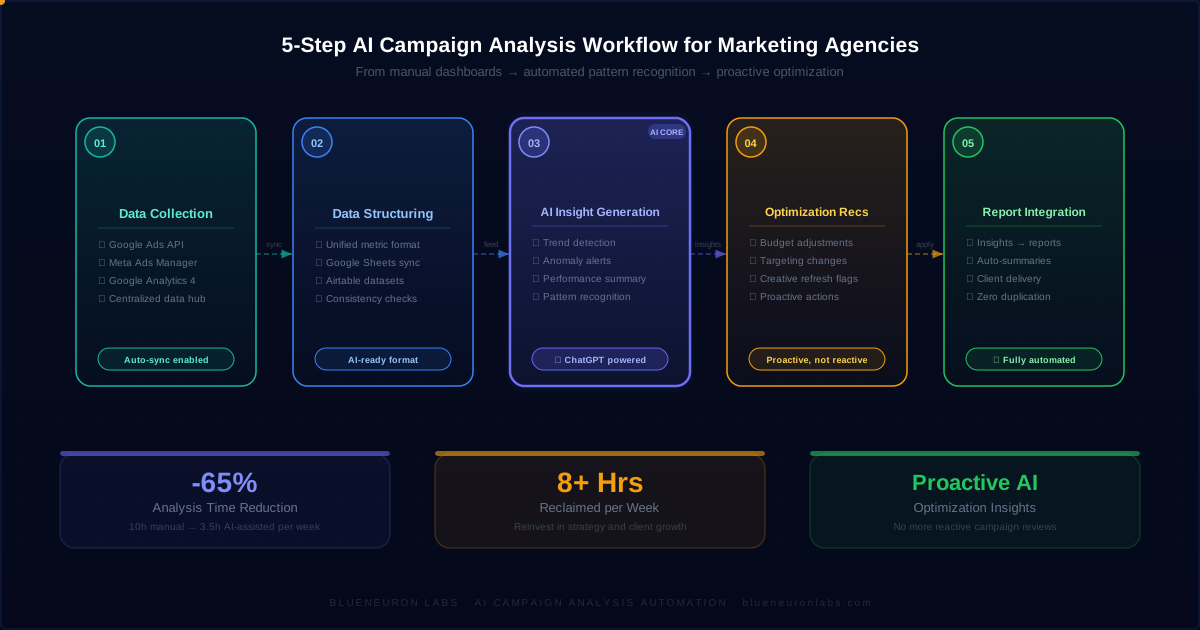
Step-by-Step AI Campaign Analysis Workflow
This is the practical system agencies can implement.
Step 1: Data Collection
What happens: Campaign data is collected from all platforms.
Sources include:
- Ad platforms (Google Ads, Meta Ads)
- Analytics tools (GA4)
- Campaign dashboards
Tools used: Google Ads, Meta Ads Manager, Google Analytics 4
Benefit: Centralizes campaign data and removes manual data gathering.
Step 2: Data Structuring
What happens: Campaign data is organized into a standardized format.
How:
- Unified metrics
- Structured datasets
Tools used: Google Sheets, Airtable
Benefit: Prepares data for AI analysis and ensures consistency.
Step 3: AI Insight Generation
What happens: AI analyzes campaign data to generate insights.
Examples:
- Identifying performance trends
- Detecting anomalies
- Summarizing campaign performance
Tools used: ChatGPT
Benefit: Reduces manual analysis and improves speed and consistency.
Step 4: Optimization Recommendations
What happens: AI suggests actionable improvements.
Examples:
- Budget adjustments
- Targeting changes
- Creative improvements
Benefit: Enables proactive optimization and improves campaign performance.
Step 5: Integration into Reporting
What happens: AI-generated insights are integrated into reporting workflows.
How:
- Insights added to reports
- Automated summaries delivered to clients
Benefit: Connects analysis to communication and reduces duplication of effort.
👉 Related: How Marketing Agencies Can Reduce Reporting Time by 70% Using AI
Tools Used in Campaign Analysis Automation
Instead of random tools, map tools to workflow:
| Workflow Step | Tools |
|---|---|
| Data Collection | Ads platforms, Analytics tools |
| Data Structuring | Sheets, Airtable |
| AI Insights | ChatGPT |
| Optimization | AI + Dashboards |
| Reporting Integration | Docs, Dashboards |
👉 See full breakdown: Best AI Tools for Marketing Agencies in 2026: Automate for Efficiency
Business Impact
Let’s quantify the value.
- Typical Scenario: 5–10 hours/week spent on analysis, repeated across campaigns.
- After AI Implementation: Reduced to 2–4 hours/week.
- Time Saved: 6–8 hours/week.
Business Impact:
- Faster campaign decisions
- Improved optimization cycles
- Better performance outcomes
This connects directly to the inefficiencies discussed in The $3,000/Month Problem Inside 5–25 Person Agencies (And Why No One Talks About It).
Common Mistakes Agencies Make
- Relying Only on Dashboards: Dashboards show data-but don’t generate insights.
- Manual Interpretation: Human analysis slows decision-making.
- No Automation Layer: Without AI, workflows remain repetitive.
- Ignoring Patterns: Most insights are predictable and repeatable.
How to Implement This in Your Agency
Follow a structured approach:
1. Step 1 - Identify Analysis Workflows
2. Step 2 - Map Inputs and Outputs
3. Step 3 - Apply AI Layer
4. Step 4 - Test with One Campaign
5. Step 5 - Scale Across Clients
👉 This is part of a broader AI Workflow Automation Strategy.
Campaign Analysis Checklist
- [ ] identify key metrics
- [ ] centralize data
- [ ] apply AI insights
- [ ] automate review process
- [ ] track improvements
Campaign Analysis Table
| Function | AI Solution |
|---|---|
| Data | Automated sync |
| Insights | AI analysis |
| Optimization | AI suggestions |
Frequently Asked Questions
👉 Related: Reduce Reporting Time by 70% Using AI · AI Workflow Automation for Marketing Agencies · Best AI Tools for Marketing Agencies in 2026
Conclusion
Campaign analysis is a core workflow in every marketing agency. But much of it is repetitive, structured, and pattern-based-which makes it ideal for AI automation.
Agencies that adopt AI for campaign analysis can:
- reduce manual effort
- make faster decisions
- improve campaign performance
The shift is simple: From manual review → to automated intelligence.
Ready to stop spending hours on manual campaign analysis?
🚀 Get My AI Workflow Setup
Most agencies don’t realize how much time is spent manually reviewing campaign performance. We build AI workflows that automate insights and optimization.