
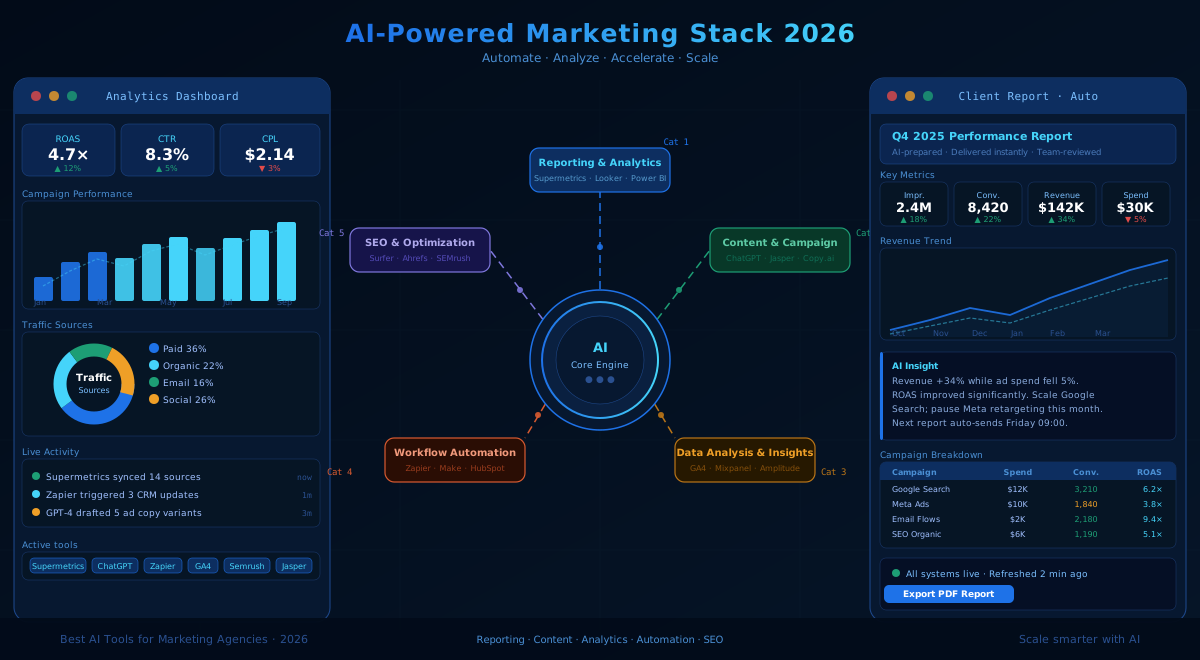
Best AI Tools for Marketing Agencies in 2026
Introduction
Digital marketing agencies today are handling more data, more campaigns, and more operational complexity than ever before.
As client expectations increase, agencies are expected to deliver:
- faster insights
- better reporting
- more personalized campaigns
- consistent performance improvements
At the same time, internal workflows are becoming more demanding. Tasks like reporting, campaign analysis, content creation, and client communication often consume a significant portion of team capacity.
This is where AI tools for marketing agencies are becoming increasingly important.
Over the past few years, AI in digital marketing tools has evolved from experimentation into practical operational use. Agencies are no longer just testing AI-they are actively integrating it into their daily workflows.
The shift is clear:
AI is no longer just a competitive advantage.
It is becoming part of the operational foundation of modern marketing agencies.
How to Think About AI Tools
One of the biggest mistakes agencies make is adopting AI tools randomly.
Many teams experiment with multiple tools without a clear strategy, which often leads to:
- tool overlap
- fragmented workflows
- low ROI
Instead, agencies should evaluate AI tools based on the workflows they want to improve.
A practical way to approach this is to group tools into four key categories:
1. reporting and analytics
2. content and campaign creation
3. data analysis and insights
4. workflow automation
This structured approach ensures that tools are aligned with real operational needs.
Categories of AI Tools for Marketing Agencies
Category 1 - AI Reporting & Analytics Tools
Reporting is one of the most time-consuming tasks in marketing agencies.
Teams often spend hours:
- collecting data from multiple platforms
- analyzing campaign performance
- formatting reports
AI reporting tools help streamline this process.
- Supermetrics
- Looker Studio
- Microsoft Power BI
Agencies use Supermetrics to pull data from platforms like Google Ads and Meta Ads into dashboards automatically.
Looker Studio and Power BI are used to:
- build automated dashboards
- visualize campaign performance
- generate real-time reports
- reduces manual reporting effort
- improves reporting consistency
- speeds up client communication
For a deeper breakdown, see our article on AI Client Reporting Automation for Marketing Agencies.
Category 2 - AI Content & Campaign Tools
Content creation is another area where agencies spend significant time.
AI tools can assist in generating:
- campaign copy
- blog drafts
- ad creatives
- social media content
- ChatGPT
- Jasper AI
- Copy.ai
Agencies use ChatGPT to draft blog outlines, campaign messaging, and email sequences.
Jasper AI and Copy.ai are often used for:
- ad copy variations
- landing page content
- marketing messaging
AI supports content creation-it does not replace creative strategy.
Human oversight is essential to ensure quality, tone, and brand alignment.
Category 3 - AI Data Analysis & Insights Tools
Understanding campaign performance is critical for agencies.
AI-powered analytics tools help interpret complex data.
- Google Analytics 4
- Mixpanel
- Amplitude
Agencies use GA4 to track:
- user behavior
- conversion events
- campaign performance
Mixpanel and Amplitude provide deeper insights into:
- user journeys
- engagement patterns
- retention metrics
- faster performance insights
- better campaign optimization
- improved decision-making
Category 4 - AI Workflow Automation Tools
Workflow automation is one of the most impactful applications of AI.
It helps agencies automate repetitive operational tasks.
- Zapier
- Make
- HubSpot
Agencies use Zapier to automate workflows such as:
- sending campaign alerts to Slack
- updating CRM records automatically
- triggering email notifications
Make is used for more advanced workflow automation across multiple systems.
HubSpot helps manage:
- marketing campaigns
- lead tracking
- customer communication
- reduces manual operational work
- improves workflow efficiency
- connects different tools into a unified system
For deeper insights, see our article on AI Workflow Automation for Marketing Agencies.
Category 5 - AI SEO & Marketing Optimization Tools
SEO remains a critical growth channel for agencies.
AI tools help optimize content and identify opportunities.
- Surfer SEO
- Ahrefs
- SEMrush
Agencies use these tools for:
- keyword research
- competitor analysis
- content optimization
- improved search rankings
- better content performance
- stronger SEO strategy
How Agencies Should Choose AI Tools
Choosing the right AI tools requires a structured approach.
Key factors to consider include:
- Integration Capability: Tools should integrate with existing systems and workflows.
- Ease of Use: Teams should be able to adopt tools without extensive training.
- Scalability: Tools should support future growth as the agency expands.
- ROI Potential: Agencies should evaluate whether the tool reduces time or improves performance.
Common Mistakes Agencies Make
Many agencies face challenges when adopting AI tools.
Common mistakes include:
- Using Too Many Tools: Too many tools can create complexity instead of efficiency.
- Tool Overlap: Multiple tools may perform similar functions, leading to redundancy.
- Lack of Workflow Integration: Tools should be integrated into workflows rather than used in isolation.
These challenges are often linked to operational inefficiencies discussed in The $3,000/Month Problem Inside 5–25 Person Agencies.
How to Implement AI Tools
Agencies should follow a structured implementation process.
1. Step 1 - Identify Repetitive Tasks
2. Step 2 - Map Existing Workflows
3. Step 3 - Select Appropriate Tools
4. Step 4 - Run Pilot Projects
5. Step 5 - Measure Results
Before implementation, agencies should evaluate readiness using an AI Readiness Assessment and consider risks through an AI Risk Assessment Template.
AI Tools Checklist for Marketing Agencies
Use this checklist to guide implementation:
- [ ] identify use case
- [ ] select tool category
- [ ] test pilot
- [ ] measure ROI
- [ ] scale implementation
AI Tools Comparison Table
| Use Case | Tool Example |
|---|---|
| Reporting | Supermetrics |
| Content | ChatGPT |
| Automation | Zapier |
| Analytics | Google Analytics 4 |
Tables like this illustrate how automated marketing workflows can simplify agency operations.
Conclusion
As marketing agencies continue to grow, operational efficiency is becoming a critical factor for success.
The increasing complexity of campaigns, data, and workflows requires new approaches to managing operations.
By adopting the right AI tools for marketing agencies, organizations can:
- automate repetitive workflows
- improve campaign performance analysis
- streamline reporting processes
- enhance overall operational efficiency
However, the key is not simply adopting tools-but implementing them strategically.
Agencies that align AI tools with their workflows and operational goals will be better positioned to scale efficiently and deliver consistent results for their clients.
Frequently Asked Questions
👉 Related: Reduce Reporting Time by 70% Using AI · AI Workflow Automation for Marketing Agencies
Ready to leverage the best AI tools for your agency?
🚀 Optimize Your Agency's 2026 AI Tool Stack
Not sure which tools will deliver the highest ROI? Get a structured audit of your current tech stack, identify high-impact AI integration points, and receive a prioritized roadmap to scale your agency's efficiency.