
AI Lead Qualification for Marketing Agencies: Automate Your Sales Pipeline
Introduction
Most marketing agencies believe their growth problem is lead generation.
In reality, it's not.
Leads are coming in-from website forms, paid campaigns, referrals, and inbound content. But somewhere between "lead captured" and "client signed," opportunities are quietly lost.
If you run a 5-25 person agency, this probably sounds familiar:
- Leads sit in your inbox for hours before a response
- Every inquiry is manually reviewed
- Follow-ups depend on who remembers to send them
- High-quality prospects go cold before you engage
This isn't a demand problem.
It's a pipeline efficiency problem.
In today's environment, speed and qualification directly impact revenue. The agency that responds first-and with relevance-wins more deals.
This is where AI lead qualification changes the game.
Instead of manually filtering, prioritizing, and responding to leads, agencies can now automate the entire workflow-reducing response time to minutes, improving lead quality, and increasing conversion rates.
In this guide, we'll break down exactly how to automate your sales pipeline using AI, step by step.
The Problem with Manual Lead Qualification
Lead qualification is one of the most important steps in your sales process. But in most agencies, it's also one of the least structured.
Here's how it typically works:
1. A lead fills out a form
2. Someone checks it manually
3. The lead is reviewed based on limited context
4. A response is drafted and sent
5. The lead is added to a CRM (sometimes)
At first glance, this seems manageable. But as lead volume increases, the cracks begin to show.
1. Every Lead Is Treated the Same
Without a structured qualification system, all leads enter the pipeline equally. This means high-value prospects are not prioritized, and low-quality leads consume valuable time.
2. Response Time Is Too Slow
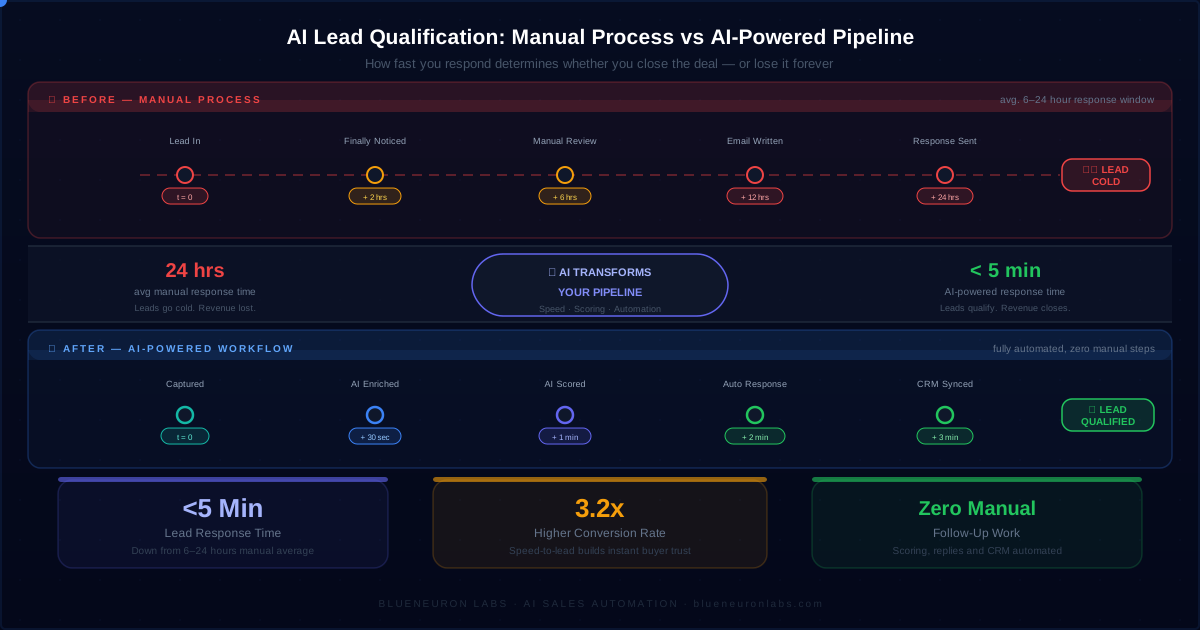
In many agencies, response time ranges from 6 to 24 hours. By that time, the prospect may have contacted competitors, urgency is lost, and conversion probability drops significantly.
3. Manual Screening Doesn't Scale
As lead volume grows, manual review becomes a bottleneck, sales teams become overwhelmed, and consistency drops.
4. Follow-Ups Are Inconsistent
Follow-ups are often delayed, forgotten, or generic-which leads to missed opportunities.
5. CRM Data Is Incomplete or Delayed
Manual data entry creates inaccurate pipelines, poor visibility, and weak forecasting.
👉 The core issue is not effort-it's structure.
This entire workflow is repetitive, rule-based, and data-driven. Which makes it ideal for AI automation.
Before vs After: Manual vs AI Lead Qualification
| Step | Manual Process | AI Workflow |
|---|---|---|
| Lead Capture | Forms only | Automated intake across channels |
| Qualification | Manual review | AI lead scoring |
| Follow-up | Delayed emails | Instant personalized responses |
| CRM Updates | Manual entry | Automated sync |
This shift transforms your pipeline from reactive and slow → to intelligent and real-time.
Step-by-Step AI Lead Qualification Workflow
This is the exact system agencies can implement to automate their sales pipeline.
Step 1: Lead Capture
What happens: Leads enter your system through multiple channels including website forms, landing pages, paid ads, and inbound campaigns.
Tools used: HubSpot, Typeform
Best Practice: Standardize all lead capture points into one centralized system.
Benefit: No lead is lost and all data flows into one pipeline.
Step 2: Data Enrichment
What happens: Raw lead data is often incomplete. AI systems enhance this by enriching data with additional context including company size, industry, revenue estimates, website analysis, and intent signals.
Tools used: Clearbit
Benefit: Better understanding of lead quality and stronger decision-making.
Step 3: AI Lead Scoring
What happens: AI evaluates each lead using predefined criteria including ICP match (ideal customer profile), budget indicators, engagement level, and business relevance. Each lead is assigned a score.
Tools used: Salesforce, ChatGPT
Example Scoring Logic:
- High-fit SaaS company → 9/10
- Small unclear business → 4/10
Benefit: Sales team focuses only on high-value leads and eliminates wasted effort.
Step 4: Automated Follow-Ups
What happens: Instead of waiting hours, leads receive immediate responses including personalized emails, meeting booking links, and qualification questions.
Tools used: Zapier, Mailchimp
Example Flow:
1. Lead submits form
2. AI scores lead
3. High-quality lead → instant email + calendar link
4. Low-quality lead → nurturing sequence
Benefit: Response time reduced to minutes, higher engagement rates, improved conversion probability.
Step 5: CRM Integration
What happens: All lead data is automatically stored and updated including pipeline stages, lead status, and interaction history.
Benefit: Accurate pipeline visibility, better forecasting, and improved team coordination.
👉 This entire system aligns with a broader AI Workflow Automation Strategy that agencies are adopting to scale efficiently.
See Other Automation Workflows:
Tools Used in Lead Qualification Automation
Instead of using random tools, successful agencies map tools to workflows:
| Workflow Step | Tools |
|---|---|
| Lead Capture | Forms, Landing Pages |
| Data Enrichment | Clearbit |
| AI Scoring | CRM + AI Models |
| Follow-ups | Automation Tools |
| CRM | HubSpot, Salesforce |
👉 See full breakdown: Best AI Tools for Marketing Agencies in 2026
Business Impact
This is where the real value comes in.
Before AI:
- Response time: 6-24 hours
- Manual qualification
- Inconsistent follow-ups
After AI:
- Response time: <5 minutes
- Automated scoring
- Consistent engagement
Measurable Outcomes:
👉 2-3x faster lead response
👉 Improved conversion rates
👉 Reduced manual workload
👉 Shorter sales cycles
Revenue Impact Example
If your agency receives 50 leads/month and converts 10% → 5 clients.
After AI, conversion increases to 15%:
👉 That's 7-8 clients/month
Even small improvements create significant revenue impact.
This connects directly to the inefficiencies discussed in The $3,000/Month Problem Inside 5-25 Person Agencies.
Common Mistakes Agencies Make
1. Responding Too Late: Speed is critical in sales.
2. No Lead Scoring System: Without scoring, prioritization fails.
3. Treating All Leads Equally: Not all leads deserve the same attention.
4. Manual Follow-Ups: This leads to missed opportunities.
5. No Workflow Structure: Tools without workflows don't scale.
How to Implement This in Your Agency
Follow this step-by-step approach:
1. Step 1 - Identify Lead Sources: List all channels generating leads.
2. Step 2 - Define Qualification Criteria: Define what a "good lead" looks like.
3. Step 3 - Apply AI Scoring: Use AI to evaluate leads automatically.
4. Step 4 - Automate Follow-Ups: Set up instant responses and sequences.
5. Step 5 - Integrate CRM: Ensure everything is tracked automatically.
Lead Qualification Checklist
- [ ] define ICP clearly
- [ ] collect relevant lead data
- [ ] apply AI scoring
- [ ] automate follow-ups
- [ ] track conversion rates
Lead Workflow Table
| Function | AI Solution |
|---|---|
| Intake | automated forms |
| Scoring | AI models |
| Follow-up | automated emails |
| CRM | auto-sync |
Frequently Asked Questions
Conclusion
Lead qualification is one of the most critical revenue drivers in any marketing agency. Yet most agencies still rely on manual review, delayed responses, and inconsistent processes.
AI transforms this workflow completely.
With AI lead qualification, agencies can respond instantly, prioritize high-value leads, improve conversion rates, and scale their pipeline efficiently.
The shift is clear:
👉 From manual sales processes → to intelligent, automated pipeline systems.
Agencies that adopt this early will not just improve efficiency-they will win more clients.
🚀 Get My AI Workflow Setup
Most agencies don't realize how many deals are lost simply due to delayed responses and inconsistent follow-ups. We build AI workflows that automate your lead qualification and sales pipeline.