
How to Build an AI System for Your Marketing Agency
Introduction: Why Most Marketing Agencies Struggle with AI Implementation
Most marketing agencies today are experimenting with AI. From small boutique teams to larger digital marketing agencies, everyone is trying to find their footing in this new landscape.
They’re using tools for:
- content generation
- reporting
- campaign insights
But despite this, results often feel… disconnected.
You might have:
- one tool for reporting
- another for content
- another for analytics
Yet nothing works together. And that’s the core problem.
👉 Marketing agencies don’t need more AI tools. They need a complete marketing automation system powered by AI.
Because without a structured system:
- workflows remain manual
- data stays fragmented
- efficiency gains are limited
This is why many marketing agencies fail to see real ROI from AI.
In this guide, we’ll break down exactly how to build an AI system for your marketing agency - step by step - so your workflows connect, scale, and deliver measurable results.
Why Most Marketing Agencies Fail at AI Implementation
Before building a system, it’s important to understand why things break inside digital marketing agencies. Most agencies approach AI like this:
- “Let’s try a few tools”
- “Let’s automate reporting”
- “Let’s use AI for content”
But they skip structure.
The Real Issues:
1. Tools Without Workflows: AI tools are added randomly without mapping actual processes.
2. No Workflow Clarity: Teams don’t define inputs, outputs, and dependencies.
3. Lack of Integration: Reporting, CRM, and campaign tools don’t talk to each other.
4. No Measurement System: No tracking of time saved, efficiency gains, or ROI.
👉 The result? AI becomes an add-on, not an operational advantage for the agency.
What a Marketing Automation System Actually Looks Like
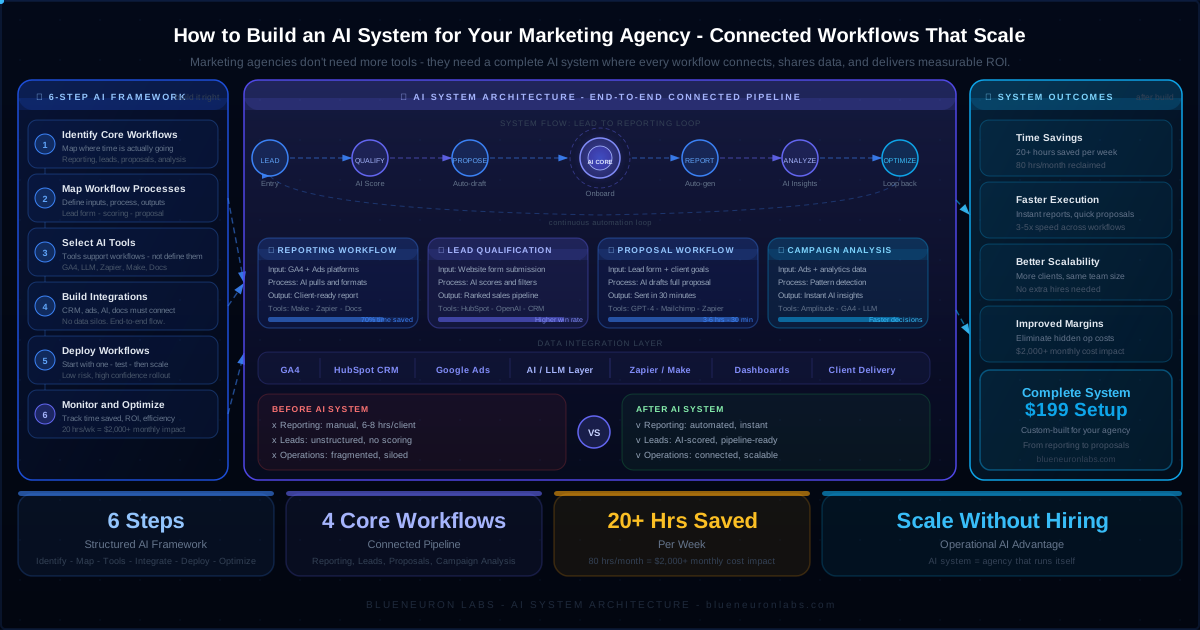
Let’s simplify this. 👉 AI System = A unified marketing automation system where workflows work together.
Not tools. Not isolated automations. A strategic system.
A Typical AI System in a Marketing Agency Includes:
- Reporting workflow
- Campaign analysis workflow
- Lead qualification workflow
- Proposal generation workflow
Each of these:
- shares data
- feeds into the next step
- reduces manual intervention
Example System Flow:
Lead → Qualification → Proposal → Onboarding → Reporting → Analysis → Optimization
Instead of:
❌ disconnected tasks
You get:
✅ a continuous, automated operational loop for your agency
Step-by-Step AI System Framework (Core Section)
Step 1: Identify Core Workflows
Start with identifying where time is actually going. Most 5–25 person marketing agencies spend time on:
- reporting
- campaign analysis
- lead management
- proposal creation
If you’ve read:
- How Marketing Agencies Can Reduce Reporting Time by 70% Using AI
- How Marketing Agencies Can Automate Campaign Analysis Using AI
- AI Lead Qualification for Marketing Agencies: Automate Your Sales Pipeline
- How Marketing Agencies Can Use AI to Generate Client Proposals Faster
You already know these workflows are repetitive and structured. 👉 These become your marketing agency's AI system building blocks.
Outcome: Clear visibility into what needs to be automated.
Step 2: Map Workflow Processes
Now go deeper. For each workflow, define:
- Inputs (data, triggers)
- Process (steps involved)
- Outputs (result)
- Input: website lead form
- Process: qualification, scoring, follow-up
- Output: proposal
- Connects directly to: sales pipeline, conversion
👉 This is where most digital marketing agencies realize: “We don’t have a people problem - we have a workflow structure problem.”
Step 3: Select the Right AI Tools
Now - and only now - choose tools. Most agencies do this first. That’s a mistake. Tools should support workflows, not define them.
If you explore Best AI Tools for Marketing Agencies in 2026: Automate for Efficiency, you’ll see tools categorized by:
- reporting
- content
- automation
- analytics
Key Principle for Digital Marketing Agencies:
👉 One workflow = one tool stack
👉 Avoid tool overlap
Example:
- Data: GA4 / Ads platforms
- AI Layer: LLM tools
- Automation: Zapier / Make
- Output: Docs / dashboards
Outcome: Clean, scalable tool architecture for your agency.
Step 4: Build Workflow Integrations
This is where the real marketing automation system becomes alive. Tools must connect. Without integration:
- data stays siloed
- workflows break
- manual work returns
What Integration Means for Agencies:
- CRM → Reporting tools
- Ads → Analytics → AI insights
- AI → Docs → Client delivery
This aligns with concepts in AI Workflow Automation for Marketing Agencies: How Agencies Can Automate Operations with AI.
Example:
Google Ads → Data pipeline → AI insights → Report → Client email. No manual steps.
Outcome: End-to-end automated workflows for your team.
Step 5: Deploy AI Workflows
Do NOT try to automate everything at once in your marketing agency.
Start Small:
- pick one workflow (e.g., reporting)
- build it
- test it
- validate output
Then move to the next:
- campaign analysis
- lead qualification
- proposals
👉 This aligns with real-world examples from AI Workflow Automation Examples for Marketing Agencies (Real Use Cases).
Outcome: Low-risk, high-confidence implementation for your digital marketing agency.
Step 6: Monitor & Optimize
This is where systems become scalable. Track:
- time saved
- errors reduced
- speed improvements
- conversion impact
If you’ve seen How Marketing Agencies Can Save 20+ Hours Per Week Using AI Workflows, you know: Time = money.
Example for Agencies:
- 20 hrs/week saved
- 80 hrs/month
- ~$2,000+ cost impact
Outcome: Measurable ROI from your agency's marketing automation system.
Before vs After AI System for Marketing Agencies
| Area | Before AI System | After AI System |
|---|---|---|
| Reporting | Manual | Automated |
| Leads | Unstructured | Qualified |
| Proposals | Slow | Fast |
| Operations | Fragmented | Connected |
Real Example: End-to-End AI System Flow
Let’s connect everything for a digital marketing agency:
1. Lead enters system
2. AI qualifies & scores lead
3. Automated follow-up triggered
4. Proposal generated instantly
5. Client onboarded
6. Reporting automated
7. Campaign analysis optimized
👉 This is not just automation. This is a complete business system for your agency.
What Happens When You Build a Marketing Automation System
This is where everything compounds for digital marketing agencies.
1. Time Savings: From manual workflows to a high-performance marketing automation system. 👉 20+ hours/week saved.
2. Faster Execution: instant reporting, faster insights, quicker proposals for your clients.
3. Better Scalability: More clients without more hires or complexity in your agency.
4. Improved Margins: This ties directly to The $3,000/Month Problem Inside 5–25 Person Agencies; you eliminate hidden operational costs.
Common Mistakes to Avoid in Marketing Agencies
1. Starting Without Workflow Clarity: Automation fails without defined processes.
2. Using Too Many Tools: More tools ≠ better system for your agency.
3. No Integration Layer: Disconnected tools break workflows.
4. No Measurement: Without tracking, you can’t optimize your digital marketing agency.
5. Expecting Instant Results: Systems take iteration.
How to Start Building Your Marketing Agency's AI System
- Step 1: Identify one repetitive workflow
- Step 2: Map inputs and outputs
- Step 3: Apply AI layer
- Step 4: Test with real use case
- Step 5: Scale across workflows
AI System Checklist for Agencies
- [ ] Identify core workflows
- [ ] Map processes
- [ ] Select AI-native tools
- [ ] Integrate systems
- [ ] Deploy workflows
- [ ] Measure results
AI System Components Table
| Component | Role in Agency |
|---|---|
| Reporting | Insights |
| Analysis | Optimization |
| Leads | Conversion |
| Proposals | Closing |
FAQ Section
🚀 Build a Complete AI System for Your Agency
Most marketing agencies don’t fail because of lack of demand. They struggle because their operations don’t scale. We help agencies design and implement end-to-end AI marketing automation systems - from reporting to lead qualification to proposals.
👉 Get your custom AI system for $199