
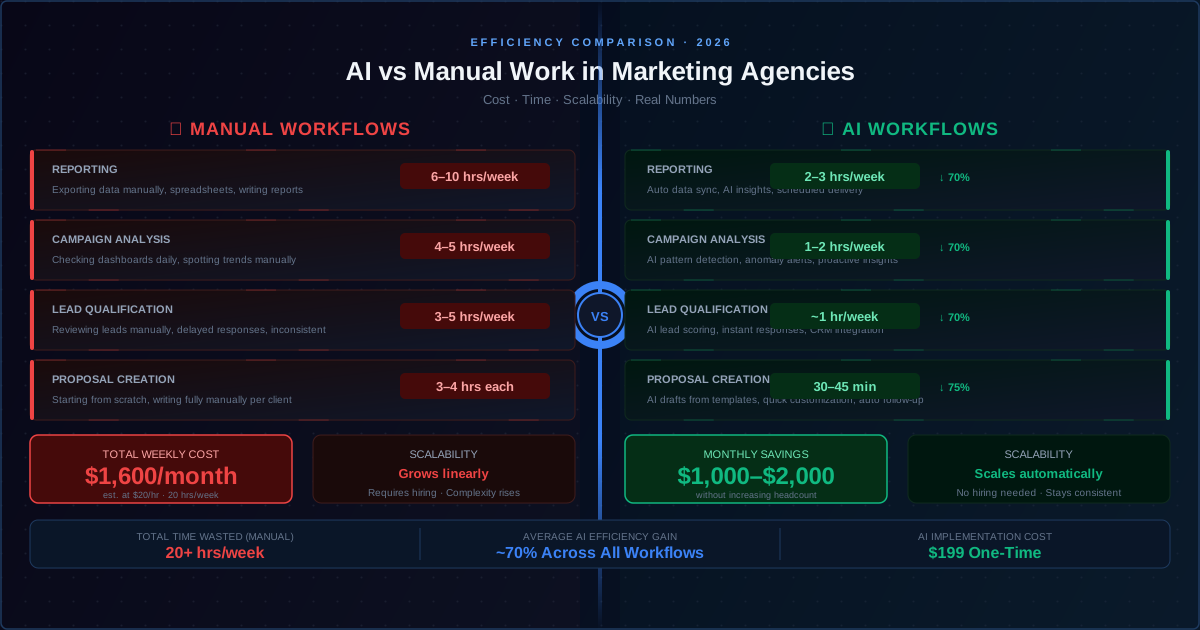
AI vs Manual Work in Marketing Agencies: Cost, Time & Efficiency Comparison (2026)
Introduction: Manual Work is Silently Killing Your Scalability
Most marketing agencies don’t realize this yet: 👉 Manual work is silently killing their scalability.
As agencies grow:
- more clients → more reporting
- more campaigns → more analysis
- more leads → more follow-ups
And suddenly, teams are overwhelmed. What used to take 2–3 hours now takes 6–10 hours per week. Not because work is harder… 👉 But because manual workflows don’t scale.
This is where the shift is happening. AI is no longer just about campaign optimization. 👉 It’s transforming how agencies operate internally.
From reporting to analysis to lead management - AI workflows are replacing repetitive manual effort. In this blog, we’ll break down:
- AI vs manual work across core agency workflows
- time and cost differences
- real efficiency gains
- where AI wins (and where it doesn’t)
By the end, you’ll clearly see: 👉 whether your agency is operating efficiently… or wasting time every week.
What “Manual vs AI Work” Really Means
Before comparing, let’s clarify something important.
Manual Work in Agencies
Manual work refers to:
- repetitive tasks handled by humans
- data pulling, formatting, reviewing
- writing reports or insights manually
- responding to leads individually
These tasks are: 👉 time-consuming, error-prone, and difficult to scale.
AI Workflows in Agencies
AI workflows refer to:
- automated data pipelines
- AI-generated insights
- automated reporting
- workflow-based automation systems
Important clarification:
- 👉 AI does NOT replace marketers
- 👉 AI amplifies efficiency
Think of it as:
- 👉 Human = strategy + creativity
- 👉 AI = execution + repetition
Core Comparison: AI vs Manual Work in Marketing Agencies
1. Reporting Workflows
Manual Approach:
- exporting data from multiple platforms
- copying into spreadsheets
- manually analyzing performance
- writing insights
- Time required: 👉 6–10 hours/week
AI Workflow:
- automated data sync (APIs)
- structured dashboards
- AI-generated insights
- auto-generated reports
- Explore full workflow: How Marketing Agencies Can Reduce Reporting Time by 70% Using AI
Outcome:
- 70% time reduction
- consistent reporting
- faster delivery
- 👉 Reporting becomes a system, not a task.
2. Campaign Analysis
Manual Approach:
- checking dashboards daily
- manually spotting trends
- reactive optimization
- Time required: 👉 3–5 hours/week
AI Workflow:
- pattern detection
- anomaly alerts
- automated insights
- proactive recommendations
- Deep dive: How Marketing Agencies Can Automate Campaign Analysis Using AI
Outcome:
- faster decisions
- better optimization
- reduced manual effort
- 👉 Analysis shifts from reactive → proactive.
3. Lead Qualification
Manual Approach:
- reviewing every lead manually
- delayed responses
- inconsistent qualification
- Time required: 👉 3–5 hours/week
AI Workflow:
- AI lead scoring
- instant responses
- automated follow-ups
- CRM integration
- Learn more: AI Lead Qualification for Marketing Agencies: Automate Your Sales Pipeline
Outcome:
- faster response time
- higher conversion rates
- better lead quality
- 👉 Leads are filtered automatically.
4. Proposal Creation
Manual Approach:
- starting from scratch
- writing proposals manually
- customizing each document
- Time required: 👉 2–4 hours per proposal
AI Workflow:
- structured templates
- AI-generated drafts
- quick customization
- automated follow-ups
- Explore: How Marketing Agencies Can Use AI to Generate Client Proposals Faster
Outcome:
- proposals created in minutes
- faster deal closure
- improved consistency
- 👉 Speed becomes a competitive advantage.
5. Content Creation
Manual Approach:
- brainstorming ideas
- writing drafts manually
- editing repeatedly
- Time required: 👉 several hours per piece
AI Workflow:
- AI-assisted ideation
- draft generation
- faster iterations
- structured content workflows
- Tools reference: Best AI Tools for Marketing Agencies in 2026: Automate for Efficiency
Outcome:
- faster content production
- improved output consistency
- reduced creative bottlenecks
- 👉 Content becomes scalable.
AI vs Manual Work: Time Comparison Table
| Task | Manual Time | AI Time | Efficiency Gain |
|---|---|---|---|
| Reporting | 6–10 hrs | 2–3 hrs | ~70% |
| Campaign Analysis | 4–5 hrs | 1–2 hrs | ~60–75% |
| Lead Qualification | 3–5 hrs | 1 hr | ~70% |
| Proposal Creation | 3 hrs | 30–45 min | ~75–80% |
| Content Creation | 5–8 hrs | 2–3 hrs | ~60% |
👉 This is where the biggest realization happens: 20+ hours/week can be eliminated.
Cost Comparison: Manual vs AI
Let’s translate time into cost.
Manual Work Cost
Example:
- 20 hours/week
- $20/hour cost
- 👉 $400/week
- 👉 $1,600/month
AI Workflow Cost
- tools + automation cost
- 👉 Significantly lower than manual labor
Net Impact
- 👉 Save $1,000–$2,000/month without increasing headcount.
- This aligns directly with: How Marketing Agencies Can Save 20+ Hours Per Week Using AI Workflows
Efficiency & Scalability Comparison
Manual Work:
- grows linearly
- requires hiring
- increases operational complexity
AI Workflows:
- scale automatically
- reduce dependency on team size
- improve consistency
👉 Key Insight: Manual work grows with clients. AI scales without hiring.
When Manual Work Still Makes Sense
To be clear: AI is not a replacement for everything. Manual work is still critical for:
- strategic decision-making
- client communication
- creative direction
- relationship building
👉 This balance is important for sustainable growth.
Common Mistakes Agencies Make
Many agencies fail not because of AI… but because of poor implementation. Avoid these pitfalls:
- using tools without workflows
- trying to automate everything at once
- ignoring ROI measurement
- overcomplicating systems
👉 *Reference:* Common Mistakes Marketing Agencies Make When Implementing AI (And How to Avoid Them)
How Agencies Should Transition to AI
Here’s a simple execution framework:
1. Step 1: Identify Repetitive Tasks - Look at reporting, analysis, and lead handling.
2. Step 2: Map Workflows - Understand inputs, outputs, and dependencies. *Reference:* AI Workflow Automation for Marketing Agencies
3. Step 3: Apply AI - Start with one workflow.
4. Step 4: Test - Run a pilot with one client or campaign.
5. Step 5: Scale - Expand across operations.
Full roadmap: AI Implementation Roadmap for Marketing Agencies (From Strategy to Execution)
AI vs Manual Work Checklist
- [ ] identify manual tasks
- [ ] calculate time spent
- [ ] prioritize automation
- [ ] implement AI workflows
- [ ] measure results
Workflow Comparison Table
| Area | Manual Approach | AI Approach |
|---|---|---|
| Reporting | manual reports | automated reports |
| Leads | manual filtering | AI scoring |
| Analysis | manual review | AI insights |
| Proposals | manual drafting | AI generation |
FAQ Section
🚀 Stop Running Your Agency Manually
Most agencies are still operating with manual reporting, manual analysis, and manual lead handling - and losing 15–25 hours every week.
We help agencies:
- automate workflows
- reduce manual work
- build AI systems
👉 Get your AI workflow for $199
---
📚 Related Blogs: Explore the Full AI Agency Playbook
Workflow Automation & Operations
- AI Workflow Automation for Marketing Agencies: How Agencies Can Automate Operations with AI
- AI Workflow Automation Examples for Marketing Agencies (Real Use Cases)
- AI for Digital Marketing Agencies: Practical Use Cases
Task-Specific AI Automation Guides
- How Marketing Agencies Can Reduce Reporting Time by 70% Using AI
- How Marketing Agencies Can Automate Campaign Analysis Using AI
- AI Lead Qualification for Marketing Agencies: Automate Your Sales Pipeline
- How Marketing Agencies Can Use AI to Generate Client Proposals Faster
- How AI Can Automate Client Reporting in Marketing Agencies
ROI & Business Impact
- How Marketing Agencies Can Save 20+ Hours Per Week Using AI Workflows
- The $3,000/Month Problem Inside 5-25 Person Agencies
- Best AI Tools for Marketing Agencies in 2026: Automate for Efficiency